The total solar eclipse of August 2026 will be one of the most significant astronomical events visible in Spain in recent decades. For a few minutes, the Moon will completely cover the Sun, plunging part of the afternoon into darkness. In the Valencian Community, the phenomenon will leave some areas in darkness, while others will experience an exceptionally deep partial eclipse. Here's how the August 2026 eclipse will appear across the region.
When is the August 2026 eclipse in Spain?
The total solar eclipse will take place on Wednesday, 12 August 2026. Across the Iberian Peninsula, the event will begin at around 7:30 pm and reach its maximum phase shortly after 8:30 pm, just before sunset.
In the Valencian Community, the eclipse will be visible between approximately 7:30 pm and 9:24 pm, with totality occurring at around 8:32 pm. Darkness duration will vary depending on the observation point.

How will the August eclipse look in the Valencian Community?
The Moon's shadow will cross the northern part of the region and gradually weaken towards the south, creating significant differences between Alicante, Castellón and Valencia.
Alicante
The eclipse will not be total anywhere in the province of Alicante, although it will be exceptionally deep. Across most of the province, the Moon will obscure around 99% of the Sun, while in the southernmost areas, including Vega Baja and Baix Vinalopó, the figure will be closer to 98%.
Although complete darkness will not occur, the landscape will take on a pronounced twilight appearance. Northern areas of the province, such as Marina Alta and El Comtat, will experience slightly greater obscuration than the south, but the Sun will remain partially visible throughout the event.
Castellón
Castellón will be the province where the 2026 total solar eclipse is most spectacularly visible within the Valencian Community. The path of totality will cross the northern part of the province, allowing municipalities such as Benassal, Morella, Peñíscola and Castelló de la Plana to experience complete darkness.
In the northern areas of the province, totality will last for up to 1 minute and 35 seconds, reaching its peak between approximately 8:31 pm and 8:33 pm. During this period, the Sun will be completely obscured, daylight will briefly give way to deep twilight, and the solar corona will become visible.

Valencia
The province of Valencia will be divided between areas experiencing totality and others that will see only a partial eclipse. Although the duration will be shorter than in Castellón, the northern part of the province, including the city of Valencia, the Los Serranos comarca and the Requena-Utiel area, will fall within the path of totality and experience complete darkness.
In the city of Valencia and its surrounding areas, totality is expected to last for approximately 1 minute and 2 seconds, reaching its peak at around 8:32 pm. Further south, in areas such as Navarrés, Ayora and La Safor, the eclipse will not be total, although the Moon will still obscure up to 99% of the Sun, creating a dramatic twilight effect.
Where to see the eclipse in the Valencian Community
To enjoy the total solar eclipse in 2026, it will be key to choose open spaces with a clear western horizon and minimal light pollution. High ground, west-facing beaches or rural areas away from tall buildings will be the most recommended.
The Valencian Community has set up several official observation points:
- Benassal (Hermitage of Sant Cristòfol, Castellón): 1 minute and 35 seconds. Capacity: 1,000 people. Due to its rural setting and high altitude, it will possibly be the best place to view the eclipse in the entire region.
- Beaches of Castellón de la Plana (from the Planetarium to the river): 1 minute and 34 seconds. Capacity: 60,000.
- Onda Castle (Castellón): 1 minute and 32 seconds. Capacity: 1,000.
- Peñíscola (park and ride): 1 minute and 30 seconds. Capacity: 5,000.
- Macastre Castle (Valencia): 1 minute and 16 seconds. Capacity: 1,500.
- Aras de los Olmos (Valencia): 1 minute and 15 seconds. Capacity: 5,000.
- Puçol Beach (Valencia): 1 minute and 14 seconds. Capacity: 1,000.
- Pico del Remedio (Utiel, Valencia): 1 minute and 6 seconds. Capacity: 600.
- Malvarrosa Beach (Valencia city): 1 minute and 2 seconds. Capacity: 5,000.
In Alicante, even if the full coverage isn't available, it's best to choose open, unobstructed spaces to get the best possible view. A public viewing will be held on the University of Alicante campus in San Vicente del Raspeig.
Events to see the eclipse in the Valencian Community
To follow the eclipse in the Valencian Community, scientific and cultural institutions have scheduled educational activities during the weeks prior and on 12 August itself.
- "Eclipse: el momento de la totalidad" projection (Hemisfèric, Valencia, from 1 July to 6 September): documentary in full dome format to understand the phenomenon.
- Solar observation day (21 July, Paseo Arbotantes, Valencia): guided session with approved telescopes and filters.
- "El eclipse de nuestra vida" Conference (21 July, Museu de les Ciències): scientific explanation of the event and the eclipse cycle in Spain.
- "Los sábados del eclipse" (25 July, Castellón Planetarium): outreach activity focused on preparing for 12 August.
- "Ecliptic Harmony" multimedia symphonic concert (31 July, Auditori de Castellón): a cultural proposal linked to the astronomical phenomenon.
- Astronomical observation of the eclipse (12 August, University of Alicante): guided monitoring of the partial maximum in the province.
- AstroCiutat astrophotography contest (from 13 August, Valencia): initiative to capture images of the eclipse.
How to view the eclipse safely
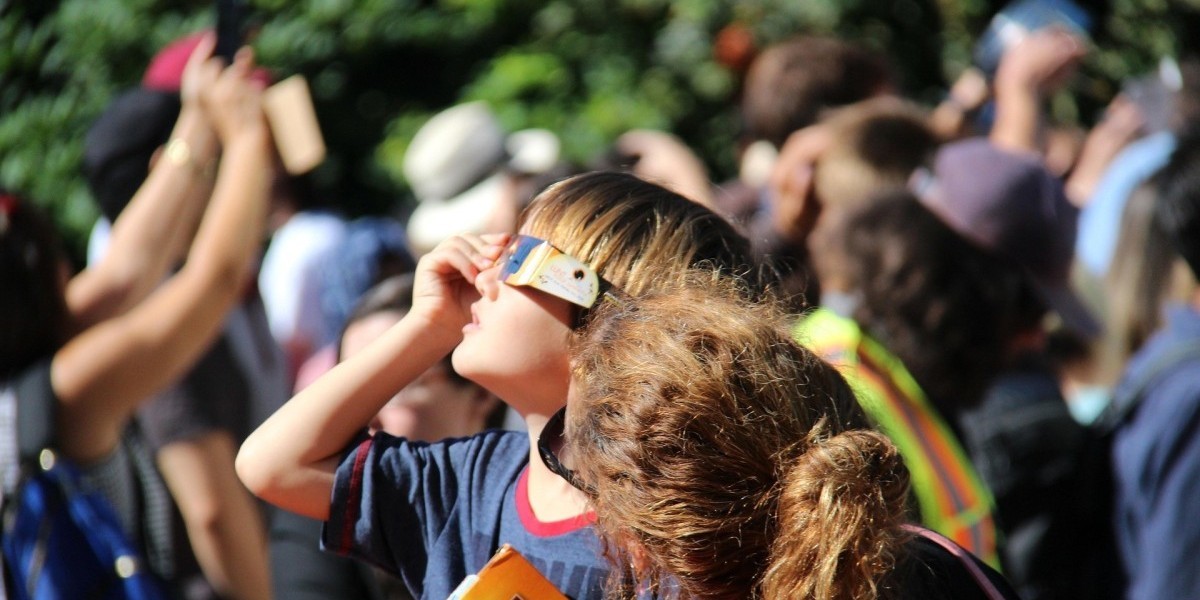
Observing a solar eclipse requires caution. Looking directly at the sun without protection can cause irreversible eye damage, even when it is partially covered. Here are some basic recommendations:
- Use only eclipse glasses with ISO 12312-2 certification.
- Do not use conventional sunglasses, X-rays or smoked glass.
- Do not look at the Sun through cameras, telescopes or binoculars without specific solar filters.
- Remove the protective covering only during the exact phase of totality and replace it as soon as the first glimmer of light reappears.
- Supervise children at all times.