Tax residency determines which country a person must declare and pay tax on their income. Understanding how it works is essential to avoid double taxation and comply with tax obligations.
Therefore, we will explain what tax residency is, how it is determined and what steps you need to take to obtain your certificate, including when you might need it.
What is tax residency?
Tax residency is the status that requires a person to declare their income in a particular country. This has several implications:
- World income. All income earned during the tax year (which coincides with the calendar year) is subject to the tax rules of the country of tax residence, regardless of whether some of it was earned in another country, as explained in Article 12.1 of the Personal Income Tax Law.
- Double taxation agreements. Agreements with other countries, many of them bilateral, determine where a person with ties to both territories must declare their income. This helps avoid paying tax twice on the same income.
- Tax residency certificate. This document, issued by the Spanish Tax Agency, certifies that the holder is a tax resident in Spain and is therefore required to pay tax there. It is particularly useful in cases of potential double taxation. Similarly, a tax residency certificate issued by another country can demonstrate to the Spanish Tax Agency that you are not required to pay tax in Spain.
- Tax planning. It is possible and legal to change your tax residence to reduce your tax bill, provided all the requirements are strictly met. Among other factors, it is important to spend fewer than 183 days of the tax year in Spain.
Requirements for tax residency in Spain
A person is considered to have their habitual residence in Spain and, therefore, must pay tax in this country in the following circumstances:
- Residency. Anyone who spends more than 183 days in Spain during the calendar year is considered a tax resident. Article 9.1 of the Personal Income Tax Law explains that occasional absences are included in this calculation unless tax residency in another country can be proven.
- Family ties. Unless proven otherwise, the Spanish Tax Agency presumes that a taxpayer has their habitual residence in Spain if their spouse or dependent minor children habitually live here.
- Economic interests. A person is considered a tax resident in Spain if the "main centre or base of their economic activities or interests, directly or indirectly", is located in the country.
In addition, residents in Spain must declare their income in the corresponding autonomous community, following the criteria set out in Article 72 of the Personal Income Tax Law.
How to apply for a tax residency certificate
A tax residency certificate can be obtained online through the Tax Agency's website. Alternatively, you can apply in person at any Tax Agency office by making an appointment in advance.
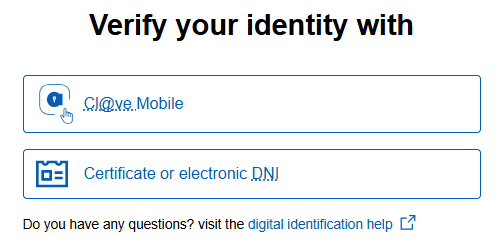
- Log in. You can access the service using your electronic certificate, electronic ID card or Cl@ve Móvil.
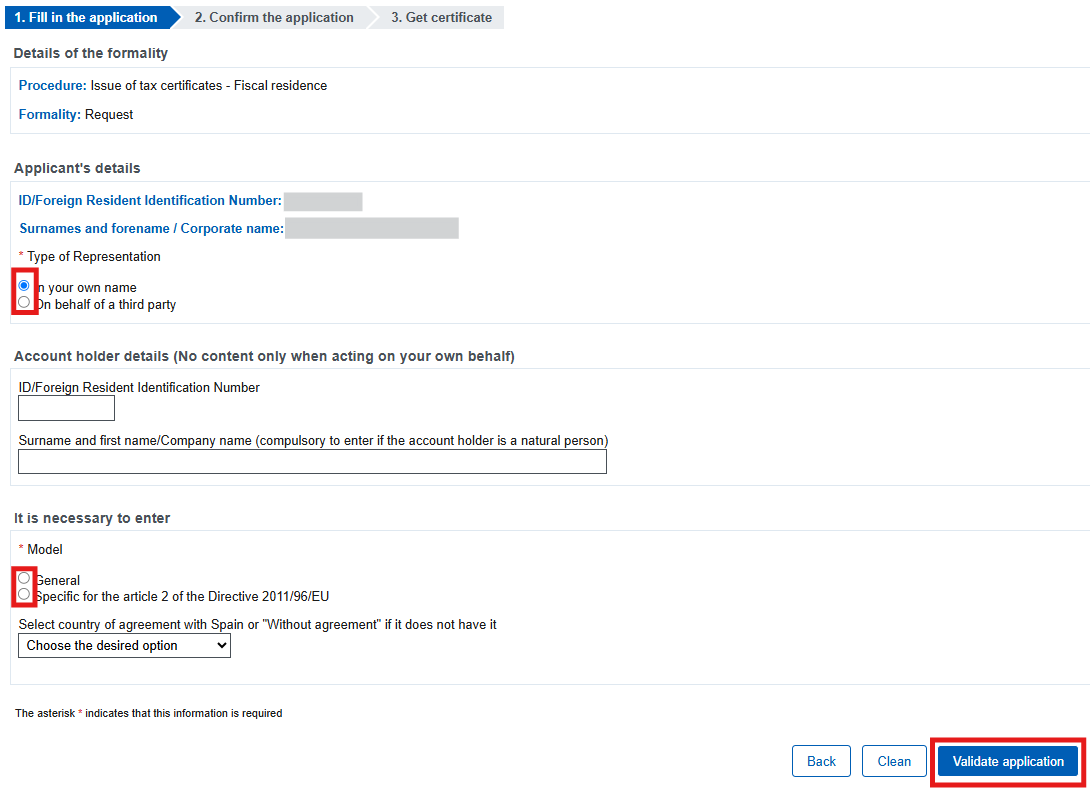
- Complete the form. You will need to provide your NIF or NIE number, along with your full name or company name. You must also specify the country with which Spain has an agreement, or select "no agreement" if there is none. Then validate your application.
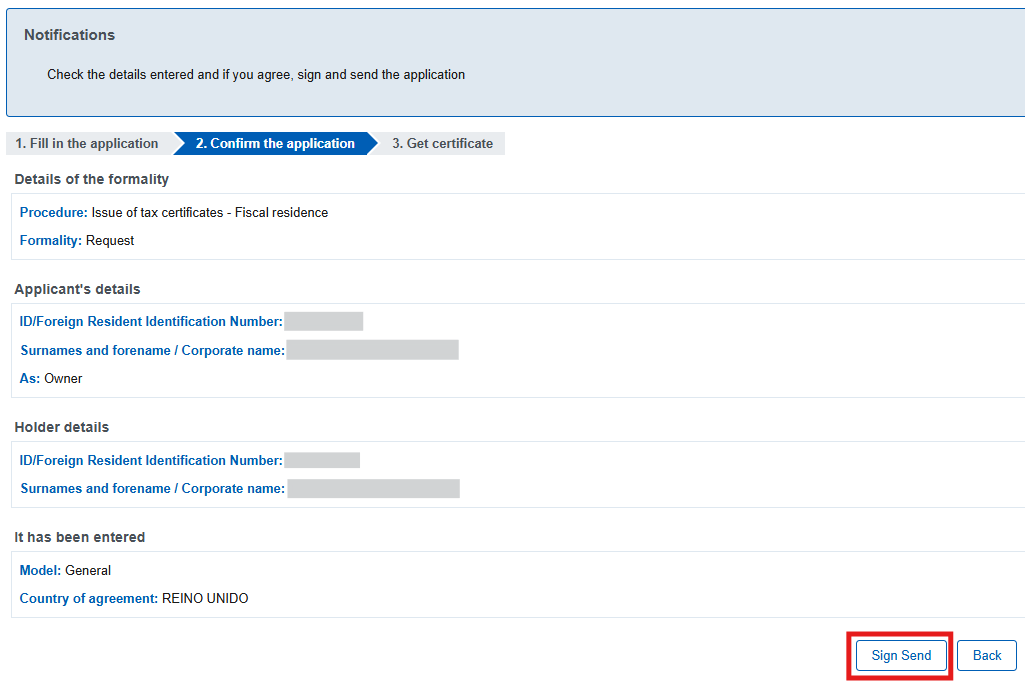
- Review and submit your application. Check that all the information is correct and click "Sign and Send". It is advisable to download the document so that you have a copy to hand in case of any queries.
What happens after submitting the tax residency application?
Once you have submitted your application, the Tax Agency may approve or reject it:
- Positive response. The tax authorities will issue the certificate immediately. To obtain it, you must provide documentation proving that you meet the requirements for tax residency in Spain.
- Negative response. You must use the "Submit documents and/or claims" procedure for issuing tax residency certificates to provide supporting evidence of your tax residency in Spain and reopen the case.
How to notify a change of tax residence
To notify the Tax Agency of a change in tax residence, you must update your tax address by submitting Form 030. Your tax address indicates your country of tax residence and, therefore, the tax system that applies to you.
Please note the following deadlines:
- Three-month period. You must report any change of tax address within three months of the change taking place.
- Exception when filing your tax return. If the deadline for filing your tax return falls within three months of the change, you must report it when submitting your return.
What is the difference between tax domicile and tax residence?
Tax domicile and tax residence are two concepts that are often confused:
- Tax residence refers to the country or territory in which you are required to pay tax.
- Tax domicile is the specific address registered with the Tax Agency for official notifications and the administration of tax obligations.
Normally, your tax residence and tax domicile coincide. However, simply changing your tax domicile to another country is not enough to prove that you are a tax resident there rather than in Spain.