Spain is heading towards a general election on 29 November, with the latest opinion polls putting the Partido Popular (PP) ahead of the governing Spanish Socialist Workers' Party (PSOE). However, the final result could depend on smaller parties, particularly Vox and regional political groups, which may hold the balance of power in the new Congress.
With 350 seats in the Congress of Deputies and 176 needed for an absolute majority, forming a government in Spain is not simply a question of which party wins the most votes. Parties may need to negotiate coalition agreements or secure parliamentary support from other groups to get their candidate elected Prime Minister.
So, what do the latest Spanish election polls say? Could the PP govern with Vox, or might Pedro Sánchez remain in power with the support of left-wing and regional parties? Here are the main possible scenarios ahead of the 2026 general election.
- What do the latest Spanish election polls say?
- How many seats are needed to form a government in Spain?
- Four possible scenarios after the 2026 Spanish election
- What could change before election day?
- What could the election mean for foreigners living in Spain?
- When will we know who forms the next government?
What do the latest Spanish election polls say?
Most opinion polls published in the run-up to the election put the PP in first place, followed by the PSOE and Vox. However, there are significant differences between individual surveys, particularly over the level of support for the two main parties.
According to Mapa Electoral's latest election polling tracker, updated on 13 November, the PP is ahead in 16 of the 18 polling organisations that have published surveys in the previous 30 days. The exceptions are the state-run Centre for Sociological Research (CIS) and SW Demoscopia, both of which put the PSOE first.
Some of the latest voting intention estimates include:
| Pollster and publication | PP | PSOE | Vox |
| 40dB (El País / Cadena SER), 13 Nov | 31.5% | 29.4% | 18.8% |
| Winston (Artículo14), 13 Nov | 31.1% | 26.4% | 18.7% |
| Sigma Dos (El Mundo), 12 Nov | 30.8% | 25.3% | 19.6% |
| CIS, 12 Nov | 25.5% | 33.3% | 18.4% |
Source: Mapa Electoral, based on the latest published surveys. Figures represent estimated voting intention, not actual election results.
The difference between the private polls and the CIS survey is particularly striking. While most private polling organisations put the PP ahead, the CIS estimates that the Socialists could receive 33.3% of the vote, compared with 25.5% for the PP.
The difference also affects estimates of parliamentary seats. The latest CIS survey puts the PSOE at between 134 and 143 seats, with the PP on 98 to 106 and Vox on 57 to 65. By contrast, several private pollsters estimate that the PP and Vox could together secure an absolute majority.
This means that there is no single agreed picture of the election. The final distribution of seats will depend on how votes are spread across Spain's different constituencies, as well as on turnout and the performance of smaller parties.
How many seats are needed to form a government in Spain?
Spain's Congress of Deputies has 350 seats. A party or combination of parties needs 176 seats to secure an absolute majority.
However, the Spanish electoral system means that the national share of the vote does not directly determine how many seats a party wins. Deputies are elected in 52 constituencies, with seats distributed according to the votes received in each one.
This is why regional parties can have considerable influence despite receiving relatively small percentages of the national vote.
It is also important to understand that Spaniards do not directly elect their Prime Minister. Voters choose their parliamentary representatives, and the Congress subsequently votes on who should lead the government.
If you are unfamiliar with the process, our guide to how Spain elects a government, including the role of Congress and the Senate, explains how parliamentary majorities and investiture votes work.
Four possible scenarios after the 2026 Spanish election
The final seat count will determine which parties can realistically form a government. Based on the polling available on 13 November, four broad scenarios are possible.
1. A PP and Vox government
One possible outcome is an agreement between the Partido Popular and Vox, allowing the two parties to govern together or for Vox to support a PP-led administration.
The PP, led by Alberto Núñez Feijóo, is Spain's main centre-right party, while Vox, headed by Santiago Abascal, occupies a position further to the right.
Most private polling estimates put their combined parliamentary representation above the 176-seat threshold. Some surveys suggest they could secure close to or above 200 seats.
However, the two parties would still need to negotiate the terms of their agreement. Vox has indicated that its support would depend on commitments covering areas including immigration, national identity and public policy.
A coalition government would involve sharing political responsibilities, while a support agreement could allow the PP to govern with fewer ministers from Vox or without Vox joining the cabinet.
2. A PP-led minority government
Another possibility is that the PP wins the largest number of seats but cannot secure an absolute majority, even with Vox.
In this situation, Feijóo could attempt to form a minority government, relying on support from other parliamentary groups or on some parties abstaining during the investiture vote.
Under Spain's parliamentary rules, an absolute majority is required in the first investiture vote. If the candidate does not obtain it, a second vote takes place 48 hours later, when a simple majority is sufficient. This means that more deputies must vote in favour than against.
A minority government would still face the challenge of negotiating support for legislation and budgets, making its ability to govern dependent on agreements with other parties.
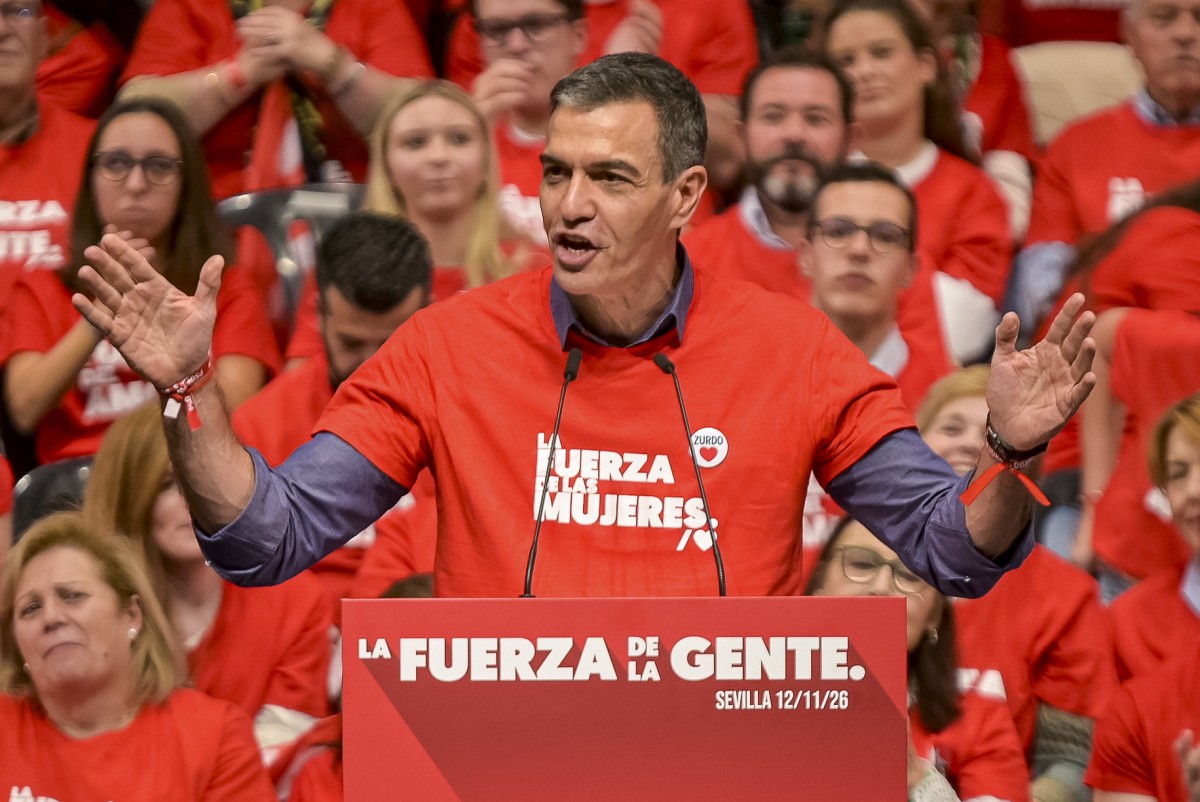
3. A PSOE-led government with support from smaller parties
The alternative would be another government led by the PSOE, with Pedro Sánchez seeking the support of parties on the left and regional political groups.
Potential partners could include Frente Amplio, Podemos and several regional parties, such as:
- ERC (Republican Left of Catalonia): a Catalan left-wing, pro-independence party.
- Junts per Catalunya: a Catalan nationalist and pro-independence party.
- EH Bildu: a Basque left-wing nationalist party.
- PNV (Basque Nationalist Party): a Basque nationalist party.
- BNG (Galician Nationalist Bloc): a Galician nationalist party.
- Coalición Canaria: a regional party representing the Canary Islands.
However, these parties do not form a single political bloc and have different priorities. Securing their support would require negotiations and potentially significant political concessions.
Junts could be particularly important. The Catalan party ended its agreement with the Socialists in October 2025, making any renewed cooperation a potential obstacle for Sánchez.
The CIS polling estimates suggest that a PSOE-led parliamentary majority could be mathematically possible, although most private surveys show a different balance of seats.
For a closer look at the parties involved, their leaders and their political positions, see our guide to Spain's main political parties explained for newcomers.
4. Political deadlock and another general election
If no candidate can secure enough parliamentary support to become Prime Minister, Spain could face another general election.
Under Article 99 of the Spanish Constitution, the King consults the political groups represented in Congress and proposes a candidate for Prime Minister. The candidate then presents their government programme and asks Congress for its confidence.
If the candidate fails to secure an absolute majority in the first vote, a second vote takes place 48 hours later. A simple majority is then sufficient.
If no candidate wins the confidence of Congress within two months of the first investiture vote, Parliament is dissolved and new elections are called.
Spain has experienced this situation before. In 2016 and 2019, political deadlock resulted in repeat general elections after parties failed to agree on a government.
What could change before election day?
Although the campaign is underway, the final result is not yet known. Several factors could influence the distribution of votes and seats before 29 November.
- Differences between polling organisations: The contrasting estimates from the CIS and private pollsters show how much voting intention can vary depending on methodology, sampling and turnout assumptions.
- Turnout: The number of people who actually vote, and which groups participate, can influence the final outcome.
- Regional parties: Support for smaller parties in Catalonia, the Basque Country, Galicia and the Canary Islands could affect the parliamentary balance.
- The division of votes on the left: Frente Amplio and Podemos are running separately in much of Spain. The distribution of votes between them could affect how many seats they secure in individual constituencies.
- Campaign issues: Housing, the cost of living, immigration, employment and public services are among the issues that could influence voters during the final weeks.
There is also a restriction on publishing electoral polls in the final days before voting. Under Spain's electoral law, opinion polls cannot be published or reproduced during the five days before election day. For the 29 November election, this means that 23 November will be the last day on which new polls can be published.
What could the election mean for foreigners living in Spain?
Although most foreign residents cannot vote in Spain's general election, the result could have important implications for people who live, work or own property in the country.
The next government will influence policies covering immigration, residency, nationality, housing, taxation and public services. These are all areas that can affect international residents, whether they are EU citizens, British nationals or citizens of other countries.
Immigration is already one of the main areas of political debate, with parties proposing different approaches to residency requirements, border controls, regularisation and access to Spanish nationality.
Our guide to residency, visas and immigration: what Spain's political parties propose looks at the main differences and what they could mean for foreign residents.
It is worth remembering that campaign promises are not laws. Even after a new government takes office, significant policy changes may require parliamentary approval and can take time to implement.
If you are unsure whether you can take part in the election yourself, read our guide to who is eligible to vote in Spain's general election. In general, only Spanish citizens aged 18 or over who are registered on the electoral roll can vote in national elections.
When will we know who forms the next government?
The election takes place on Sunday 29 November 2026, but the result will not necessarily mean that Spain has a new Prime Minister immediately.
The main dates in the government formation process are:
| Date | What happens |
| 29 November 2026 | Spaniards vote in the general election. Polling stations close at 20:00, with provisional results announced afterwards. |
| 23 December 2026 | The newly elected Congress and Senate meet for their first sessions. |
| After 23 December | The King consults the parliamentary groups and proposes a candidate for Prime Minister. |
| Following the nomination | The candidate faces an investiture vote in Congress. |
The outgoing government remains in office in a caretaker capacity until a new administration is appointed.
If negotiations are complicated, the process could take several weeks or longer. The key question will not simply be which party wins the most seats, but which candidate can secure the confidence of Congress.
For now, the latest polls offer different possible outcomes, with the PP, PSOE, Vox and regional parties all playing important roles in the parliamentary arithmetic. The final answer will only become clear once the votes have been counted and the negotiations begin.
This article reflects polling and electoral information available up to 13 November 2026. Opinion polls are estimates of voting intention, not predictions of the final result, and may change as the campaign progresses.