Investing in funds is a common way to grow your savings – but it comes with tax implications that must be reflected in your tax return. Here’s how investment funds are taxed in Spain and which sections of the return you need to complete.
Follow idealista/news on the WhatsApp channel (in Spanish)
When are investment funds subject to income tax?
You only need to include investment funds in your tax return when you realise gains or losses – either through a sale or by receiving distributions.
If you’re wondering whether they are taxable without selling, the answer is no – you are not required to declare the amounts invested, only the gains or losses generated.
Declaring investment funds
As for how investment funds are declared on your tax return, this depends on their type:
- Accumulation funds: You must declare when you sell the fund – at that point, a capital gain or loss is generated. In both cases, the amount must be declared, either to pay tax or to offset losses against other gains within the savings tax base.
- Distribution funds: In this case, returns are received as dividends – these are treated as income from movable capital and are included in the savings tax base.
What tax is withheld from investment funds?
The tax withheld from investment funds varies depending on the situation:
- In the case of a sale, a 19% withholding is applied to any profit – this is managed by the financial intermediary. If there is a loss, no withholding is applied.
- For dividends received from investment funds, the financial intermediary also applies a 19% withholding on the returns generated.
Gains or losses from the sale of investment funds are included in the savings tax base, where they are combined and offset against other capital gains and losses. In the case of dividends, these are treated as income from movable capital within the same savings base.
The corresponding tax rates are then applied to the total amount, according to the marginal scale for savings income:
Capital gains or losses from the sale of investment funds
To calculate the capital gains or losses from the sale of investment funds:
- Subtract the purchase value from the sale value.
- The resulting figure – whether positive or negative – is treated as a capital gain or loss within the savings tax base.
- For capital gains or losses to arise, there must be a change in the composition of your assets and a variation in their value as a result of that change.
How to report investment funds on the tax return in Spain
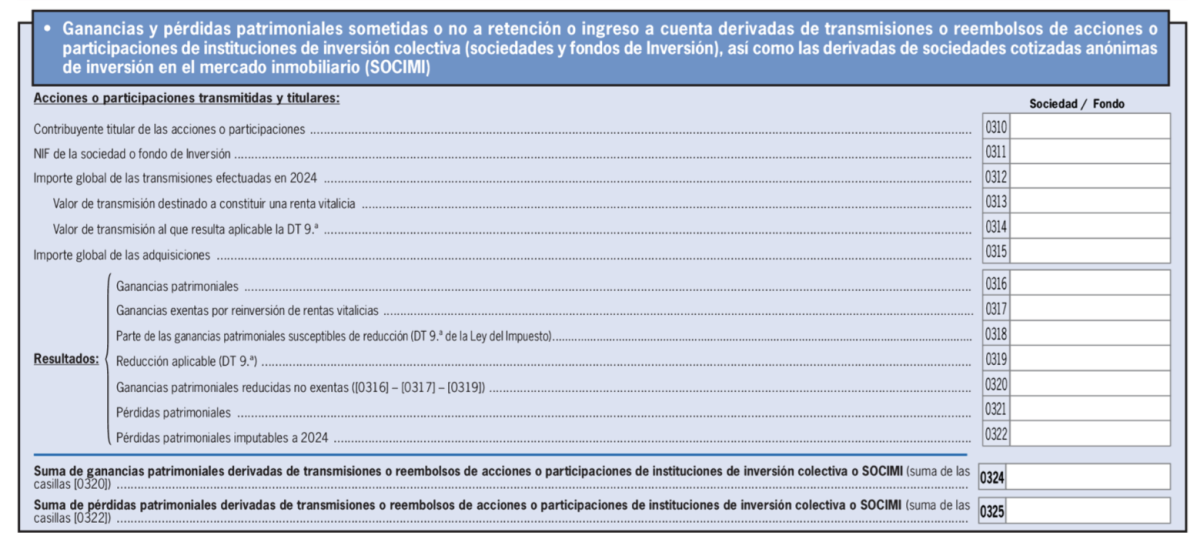
Capital gains or losses derived from selling investment funds are included in boxes 310 to 316.
Dividends from investment funds are included in box 029, as income from movable capital.

How much tax relief does an investment fund offer?
The main tax advantage of investment funds is tax deferral – allowing you to transfer money from one fund to another without being taxed.
There are also deductible expenses linked to investment funds. These include costs associated with buying and selling – such as administration and custody fees or trading commissions – which are taken into account when calculating any resulting gains or losses.