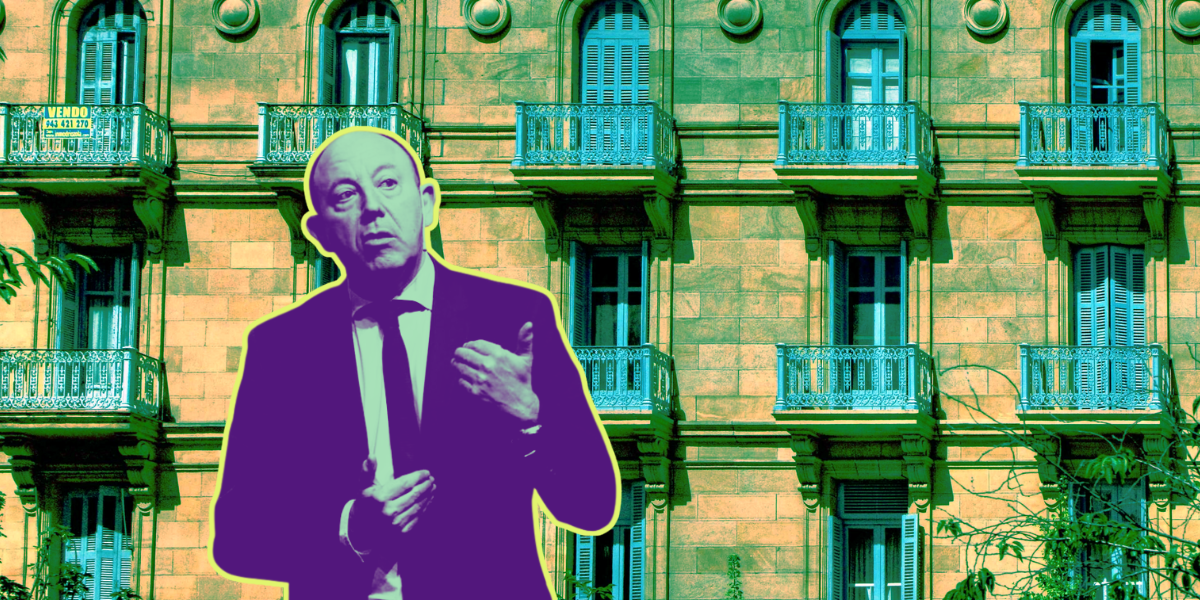

For Spanish economist Gonzalo Bernardos, the debate over tourist flats in Barcelona has been based on a fundamental misunderstanding. “The story has wiped out the facts,” he told a packed audience at the Círculo Ecuestre, where he discussed the real impact of banning short-term rentals. In his view, politicians and activists have picked an easy target, while ignoring the deeper issue: a chronic housing shortage.
Bernardos didn’t hold back. “Getting rid of tourist flats is not going to make rents fall,” he said, pointing to the numbers. In Barcelona, tourist properties account for just 1.18% of the total housing stock. “Thinking that removing that tiny fraction will solve housing access makes no sense,” he added. For him, the effect of tourist rentals on prices is “practically nonexistent.”
Looking beyond Barcelona, the picture is similar across Spain. Tourist flats make up just 1.43% of the national housing stock, with most concentrated along the coast rather than in major cities. “The six largest cities in Spain hold 16.8% of the population, but only 12.6% of tourist accommodation,” Bernardos highlighted. These figures, he argues, completely undermine the idea that short-term rentals are “invading” urban housing markets.
For Bernardos, the real problem is structural: there simply aren’t enough homes. “Access to housing is a supply problem,” he stressed. “And without supply, no regulation will work.” He was particularly critical of policies that discourage investment. “When the message goes out that investing in housing is risky, investment disappears,” he warned. “And when investment disappears, prices rise.”
He also challenged what he sees as an ideological campaign against tourism. “There is a crusade against tourism here,” he said bluntly. Tourism contributes 12.6% of Spain’s GDP – almost exactly the same as in 2019. “There hasn’t been uncontrolled growth,” he explained. Yet a narrative is taking hold that tourism is the root of all urban problems. “We are about to kill the goose that lays the golden eggs,” he declared.
Bernardos defended the role of visitors and the so-called “floating population” in the urban economy. “Who do you think fills restaurants, shops, and cultural venues during the week? Visitors and commuters,” he asked. For him, a diverse, open, and vibrant city is a healthy city. “A homogeneous city, where only locals live, is a perfect example of failure,” he said.
He also mocked the romanticised idea of a quiet, tourist-free Barcelona. “We want a city without noise, suitcases, or tourists,” he said wryly. “But then we expect the same level of economic activity.” Bernardos reminded the audience that neighbourhoods like Poblenou once coexisted with far noisier industries. “There used to be factories constantly whistling – now we’re scandalised by the sound of rolling suitcases,” he joked.
One of the most striking parts of his talk was his analysis of restrictive policies. Limiting or banning activities without increasing housing supply, he warned, simply drives markets underground. “When landlords earn less or feel persecuted, they leave the market,” he explained. “And when supply disappears, demand explodes, and shady practices emerge.”
In heavily regulated markets, he added, flats often vanish from listings altogether. “Agencies don’t advertise them because they’d be swamped with calls,” he said. The result? Under-the-table payments, hidden surcharges, and even bigger obstacles to finding a home. “This isn’t theory – we teach this in first-year university,” Bernardos stressed.
For him, the debate around tourist flats is a smokescreen. “They aren’t the problem,” he said. “The problem is that we aren’t building enough homes.” Until that reality is addressed, he warned, any measures will remain ineffective. “Banning is easy,” he said. “Governing is much harder.”
He closed with a clear call for evidence-based policy. “When you weigh the benefits of tourist flats against their supposed harm, the balance is overwhelmingly positive,” he said. Against the political noise, he urged a return to the facts. “Without numbers, there is no housing policy,” he concluded. And without a serious commitment to building more homes, he warned, Barcelona risks impoverishing itself while believing it’s solving a problem that hasn’t gone away.