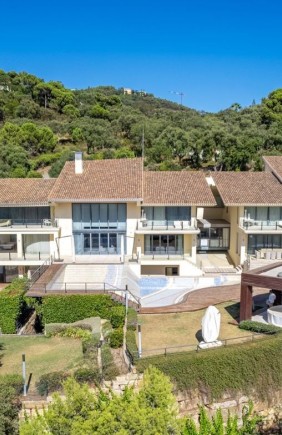
US and Latin American nationals are playing an increasingly prominent role in Spain’s luxury real estate market. While European buyers were once the dominant group in the premium segment, the presence of buyers from both North and South America has grown significantly since the COVID‑19 pandemic.
Follow idealista/news on the WhatsApp channel (in Spanish)
One of the leading figures in this sector is Bruno Rabassa, CEO of Berkshire Hathaway HomeServices Spain, the real estate firm founded by Warren Buffett. In an interview with idealista/news, he analysed the current state of the luxury market in Spain and explained how the company is attracting buyers from the United States.
During the conversation, Rabassa highlighted the strong momentum of the Spanish market and the growing interest from international investors. He also stated that Spain is increasingly referred to as the “Florida of Europe”, describing it as an ideal destination both for retirement and for raising a family. He added that a growing number of young professionals are choosing to live in Spain, drawn by remote working opportunities, high quality of life and strong international connectivity.
What is your current situation?
We are consolidating our position in the markets where we operate. We currently have ten offices open in Spain and are seeing strong demand from foreign buyers who want to move to the country and adopt our lifestyle, which is our main attraction.
Spain is not only one of the most visited countries in the world, but it also boasts one of the highest life expectancies. We offer a way of life that matches exactly what many buyers are looking for.
As someone originally from the United States, have you noticed an increase in American buyers in recent years?
I’ve recently spent three weeks in the United States and another week in Latin America, and I was struck by how well Spain is now positioned on the map in the US – something that wasn’t the case years ago. As for Latin American buyers, Spain has always been a well‑established destination, and interest in investing in the Spanish property market remains strong.
We should also not overlook the rest of Europe, where Spain continues to be highly attractive. It is often described as the “Florida of Europe” – an ideal place to retire and, for those not yet at that stage, a wonderful environment in which to raise a family. We offer a wide range of international schools and a strong capacity to welcome foreign residents in many ways.
I spent three weeks in the United States and one in Latin America, and I was struck by how well Spain is positioned on the map in the US – something that wasn't the case years ago.
The country is performing exceptionally well. However, the biggest challenge is supply. Demand remains strong, but there is an increasing shortage of available housing, making it difficult to balance supply and demand.
What are your key locations in Spain?
We are present on the Costa del Sol, which continues to be extremely popular, and in Mallorca, which has seen significant growth over the past two years. In Mallorca, German and British buyers have shown some caution due to economic fluctuations.
The Costa Blanca, with our offices in Dénia and Altea, is also performing very well, closing increasingly significant transactions with higher investment volumes.
Naturally, Madrid and Barcelona remain key markets. However, from the perspective of foreign buyers, Madrid has gained prominence over Barcelona. This is partly influenced by the political climate in Catalonia and perceptions of safety, both of which are important factors in lifestyle decisions.
Barcelona experienced its peak following the Olympic Games, and today most of its buyers are domestic. In contrast, Madrid has a much higher proportion of international clients.
Madrid has gained prominence over Barcelona. The political climate in Catalonia and perceptions of safety likely play a role.
What is the share of international buyers? Can you differentiate between Europeans, Latin Americans and Americans?
It depends greatly on the location. In Madrid, more than 85% of luxury buyers are Latin American, while in Barcelona, around 90% are Spanish.
In other areas, the profile is more varied. On the Costa del Sol, British buyers dominate, while on the Costa Blanca, there is a mix of Belgians, Poles and a more diverse international clientele.
An interesting trend we have observed is that many Latin American buyers, once established in Madrid, begin to explore other attractive areas. They often look for larger properties in locations such as La Moraleja, but also purchase second homes in destinations like Marbella, Sotogrande or the Costa Blanca. Some also invest in northern regions such as Cantabria, Asturias, Galicia and the Basque Country, although in smaller numbers.
American buyers tend to arrive with a more open approach: some look for city living, others prefer coastal properties, and many are also drawn to mountain locations.
In Madrid, more than 85% of luxury buyers are Latin American, while in Barcelona, 90% are Spanish.
Does being associated with Warren Buffett’s company help attract American customers?
It certainly works in our favour. We have more than 1,600 offices worldwide and over 60,000 agents.
At the annual convention in the United States, there were around 5,000 attendees. In the past, we had to introduce ourselves to the market – now the situation has reversed, and agents approach us because they have American clients interested in buying in Spain.
In the United States, high‑net‑worth individuals typically work with a trusted real estate agent. Our presence in Spain makes it easier for those professionals to recommend our services and properties.
In addition, many of these clients use financing, even if they have significant wealth. If they can secure a mortgage at around 2.5% while their investments generate returns of 7%, 8% or even 10%, it allows them to preserve their capital.
Ultimately, the association with Warren Buffett adds a strong layer of credibility, backed by rigorous processes. Clients often arrive with part of the groundwork already done, which gives them greater confidence and peace of mind.
Before, we were the ones who had to make ourselves known, and now they are the ones who seek us out because they have American clients interested in buying in Spain.
Have you noticed an increase in the number of luxury buyers purchasing without financing?
It depends on the segment and the type of property. There is a tax known as the Solidarity Tax, which applies to assets exceeding €3.6 million. Many buyers are well advised and, if they can obtain financing at low rates, they prefer to do so as part of a tax optimisation strategy.
How do you assess a potential rise in interest rates in Europe?
Europe currently has lower interest rates than the United States, but it will inevitably feel the effects. This was already seen after COVID, when large volumes of cheap capital were borrowed, contributing to rising inflation and subsequent interest rate adjustments.
If rates are increased again, I believe they would remain at reasonable levels. In my view, what was not sustainable was the exceptionally low Euribor levels during the pandemic, which did not make economic sense.
This potential price increase is linked to the conflict in the Middle East. Do you think this situation will attract buyers to Spain?
It is already happening. I have recently signed an agreement with a Kuwaiti company that is sending us buyers with very competitive offers.
Spain continues to act as a magnet for international investors. However, the main challenge lies in the lack of supply – although this is less evident in the luxury segment, which tends to be more stable.
And what about supply in the residential sector?
The issue is that public and private initiatives are moving at different speeds. Administrative processes for licences, permits and utilities are often excessively slow. This is compounded by challenges related to electricity supply.
There are four key factors to consider: a shortage of available land, the fact that much of the land is not particularly attractive for development, rising construction costs – largely due to labour shortages – and the complexity of bureaucratic procedures involved in obtaining licences.
The problem is that public and private initiatives move at different speeds. Bureaucratic processes for licenses, permits, and supplies drag on endlessly.
What is the perception among international buyers regarding the messages coming from the government?
There are always political signals to interpret. The reality is that there is a serious structural housing problem, and it cannot be attributed to short‑term rentals, as is sometimes suggested.
In the luxury segment, the elimination of the “golden visa” had a limited impact on overall property sales. While it served as a useful marketing tool, a large proportion of foreign transactions were not driven by it. Moreover, buyers in this segment are not competing with the middle class for housing, so its removal has had little effect on affordability.
Another example is the Solidarity Tax. High‑net‑worth buyers often respond by structuring purchases with financing, which reduces their tax exposure. In that sense, it becomes more of a political message than a real deterrent for international investment. Overall, these measures are not perceived as especially negative abroad.
What do you propose to policymakers regarding housing?
Very little: essentially, to do less but do it more efficiently – streamline licensing processes and promote vocational training so that young people can enter the construction sector.
Returning to the luxury real estate market, what changes have you observed since COVID?
COVID transformed the market. People’s mindset shifted significantly – there is now a stronger focus on enjoying life and making the most of it. Sales of yachts and private jets increased notably.
Spain also emerged as an especially attractive destination after the pandemic, which boosted investment in luxury assets within the country.
How has the profile of the luxury buyer evolved? Is it still mainly older individuals coming to Spain to retire?
Not at all. For example, in La Zagaleta – one of the most prestigious and exclusive residential developments in Spain – the typical buyer profile is now successful professionals between 35 and 45 years old.
Do these buyers move to Spain permanently or use it as a second home?
We are seeing that many luxury buyers are choosing to live in Spain with their families and children. When they need to travel to the United States or other parts of Europe, they can easily do so, as Spain is an exceptionally well‑connected country.
We have a fibre‑optic network that is the envy of many countries – for example, large parts of London still lack this level of connectivity. We also offer direct international flights to major destinations and one of the largest high‑speed rail networks in the world, second only to China – although it is currently not operating at its peak efficiency.
In addition, we have a strong healthcare system, a rich cultural heritage, renowned gastronomy, a favourable climate and a diversity of landscapes, from beaches to mountains. Altogether, Spain is an exceptional place to live.
Golf courses and international schools are often key factors in luxury real estate. How do you assess their importance?
Absolutely. According to our estimates, there are around 70 golf courses in the Marbella area, meaning that from almost any location, you can reach one within an hour’s drive. The range of golf options is extensive, both there and across much of the country.
As for international schools, they are a decisive factor. I recently met with a senior American executive considering moving to Spain, and he had three priorities: enrolling his daughter in an international school, practising scuba diving and having access to golf facilities.
Has the arrival of more international buyers led to a decline in domestic demand?
Prices have risen sharply. We often say that yesterday was the best time to buy. With the current shortage of housing, prices have continued to climb at a rapid pace, although we are now starting to see a slowdown in sales.
Demand has not disappeared. However, domestic buyers perceive prices differently from international clients and are not fully convinced by current levels. Many may be waiting for some form of adjustment in the market before making a decision.
Prices have risen sharply. We often say that yesterday was the best day to buy. With the current housing shortage, prices have continued to climb at a rapid pace.
And finally, how do you see the future of your company and the luxury sector?
I expect a positive, upward trend in 2026. We anticipate an increase in transactions, and we are already seeing average ticket sizes continue to rise. However, the main challenge will be aligning supply with demand. Not everything is acceptable, and not everything can be considered luxury.