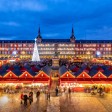
Puerta del Sol is one of Madrid's most recognisable landmarks: a popular meeting point, the setting for the New Year's Eve chimes and the starting point of several of Spain's radial roads. Thousands of people pass through it every day, surrounded by historic buildings and some of the city's most iconic symbols. Yet its name dates back to a very different Madrid. Discovering why Puerta del Sol bears this name means uncovering part of the history of the Spanish capital's historic heart.
What is the history of the Puerta del Sol in Madrid?
The present-day Puerta del Sol began to take shape around one of the gates in the wall that protected Madrid during the 15th century. At the time, it was not a large square but an area located on the eastern edge of the city, close to one of its main entrances.
During the 16th century, Madrid expanded, and this area gained increasing importance. It became a busy thoroughfare, particularly after Philip II established the royal court in the city in 1561. Subsequent urban reforms removed the old defensive structures and gradually opened up the space.
The square underwent one of its most significant transformations in the mid-19th century. Following the demolition of numerous buildings and the reorganisation of surrounding streets, it acquired its distinctive semi-circular shape. The Royal Post Office, now the seat of the Presidency of the Community of Madrid, was established there.

The origin of the name Puerta del Sol
The most widely accepted explanation traces the name to an old gate in Madrid's city wall. Located on the eastern side of the city, this entrance either displayed a depiction of the sun or was associated with its position facing the sunrise. This is believed to be the origin of the name Puerta del Sol, or "Gate of the Sun".
One theory suggests that the gate faced east, in the area now occupied by Calle de Alcalá and Carrera de San Jerónimo, where the sun rises. Another maintains that a sun symbol was painted or placed as a decorative feature on the gate, eventually becoming the identifying mark of the entire area.
Although the gate disappeared centuries ago, its name endured. As Madrid expanded and the walls vanished, the former entrance gave way to a central square that still preserves the memory of that historic boundary.
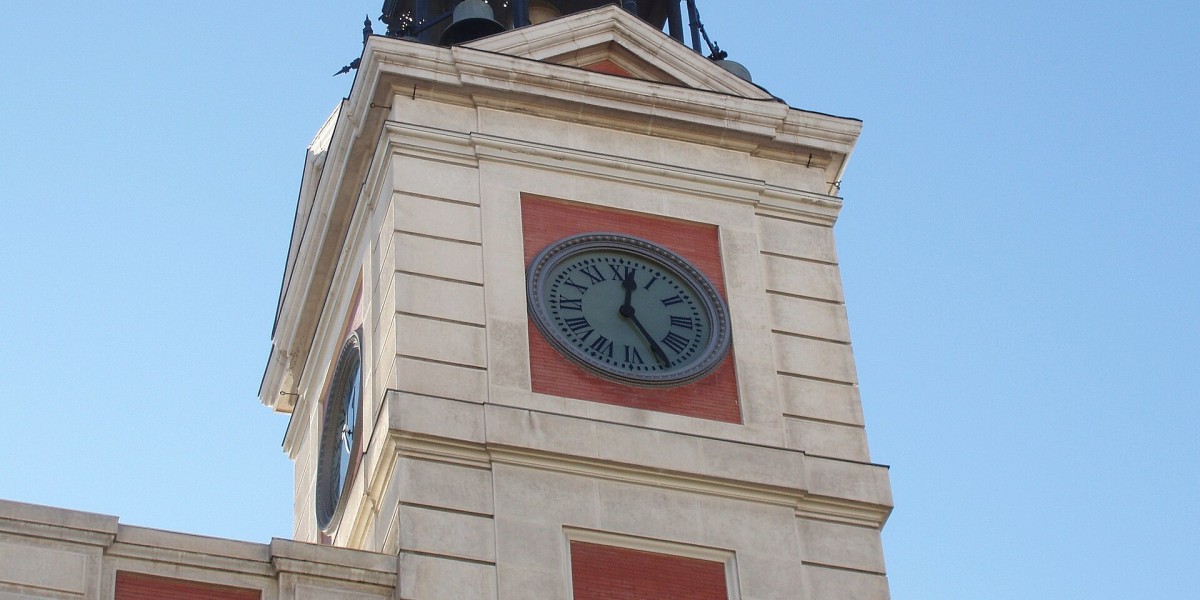
Why does the Puerta del Sol clock use IIII instead of IV?
The clock on the Royal Post Office displays four o'clock in Roman numerals as IIII rather than the more commonly used IV. This is not unique to Madrid, as many historic clocks and watch dials employ this notation, known as the "clockmaker's four".
One of the most common explanations relates to the aesthetic appearance and visual balance of the clock face. Using IIII creates a more symmetrical composition with VIII on the opposite side of the dial and can make the numerals easier to read at a glance.
How to get to Puerta del Sol
Puerta del Sol is one of the best-connected locations in central Madrid. The main ways to reach it are:
- Metro: Sol station is served by lines 1, 2 and 3.
- Renfe Cercanías: Sol's underground station is connected to several commuter rail services.
- City bus: Numerous EMT routes stop in or around the square, including along Alcalá, Gran Vía, Sevilla, Carrera de San Jerónimo and Mayor streets.
- On foot: It is just a short walk from landmarks such as Plaza Mayor, Gran Vía, Calle de Alcalá, Plaza de Cibeles and the Literary Quarter.
- Public bike: Bicimad stations are located near the square and surrounding streets.
- Taxi or ride-hailing services: Access may vary depending on traffic restrictions in the city centre.
Living in Sol
Living near Sol means residing in one of Madrid's most vibrant districts. The neighbourhood offers a high concentration of shops, restaurants, theatres, services and transport links, while also placing residents close to many of the capital's leading cultural and tourist attractions.
In return, it is an exceptionally busy area, with high levels of pedestrian activity throughout the year and especially during weekends, public holidays and major events.