Spain has two big national parties, several smaller ones, and a group of regional parties that often decide who governs. Nobody has won an outright majority in recent elections, so every party matters, including ones you may never have heard of. This guide introduces the main players ahead of the 29th November general election, in plain terms and without taking sides.
In short:
- Two parties lead: the Socialist PSOE on the centre-left and the People's Party (PP) on the centre-right.
- Smaller national parties sit to the left and right of them and often hold the balance.
- Regional parties from places such as Catalonia, the Basque Country, Galicia and the Canary Islands can decide who reaches 176 seats.
- Governments are built by deals, so the party with the most seats does not always lead the government.
The big picture: two blocs and the parties in between
For decades power in Spain alternated between the PSOE and the PP, the equivalent to the UK Labour Party and the Conservatives. Several newer parties have since joined them in Congress, and in the 2023 election no party came close to the 176 seats needed for a majority.
Politics now splits roughly into two camps, plus the regional parties:
- The left bloc: the PSOE and the parties to its left, currently Frente Amplio (the relaunch of Sumar) and Podemos.
- The right bloc: the PP and Vox, with the small Navarrese party UPN as an occasional ally.
- The regional parties: Catalan, Basque, Galician and Canarian parties that stand only in their own regions. They are not part of either camp, and several have backed governments of both sides at different times.
The 2023 government was built from the PSOE, Sumar and most of the regional parties. That majority broke in October 2025 when the Catalan party Junts ended its agreement with the Socialists. A parliament with this many parties is why this election is about arithmetic as much as about who finishes first.

The main national parties
These five parties stand almost everywhere in Spain. Positions are described relative to the main party on each side. Some outlets use stronger labels, such as "far right" or "far left", for the parties at either end, and the parties themselves often reject them.
| Party | Leader | Where it sits | What to know |
| PSOE (Socialist Party) | Pedro Sánchez | Centre-left | Led the government since 2018, most recently in coalition with Sumar. |
| PP (People's Party) | Alberto Núñez Feijóo | Centre-right | Won the most seats in 2023 but could not form a government. Leads most polls. |
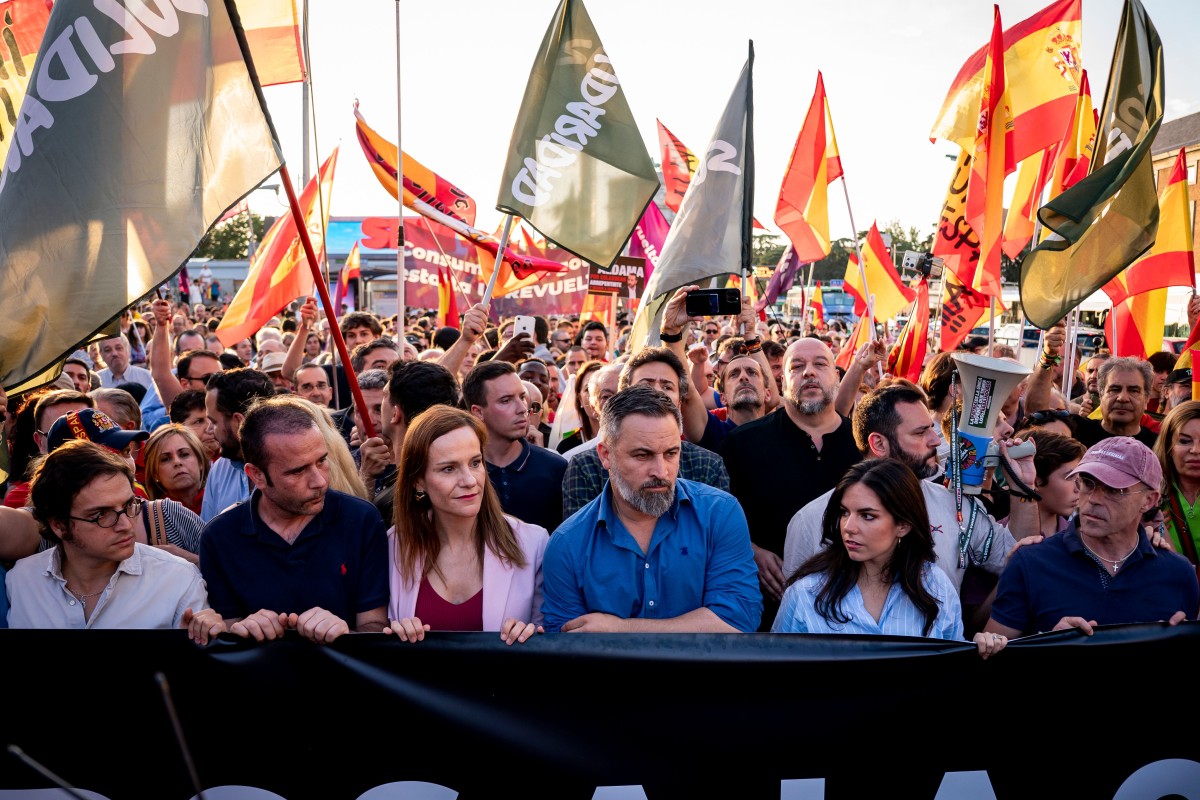
| Vox | Santiago Abascal | Right, to the right of the PP | Polling at its highest level so far. Immigration and security are central to its campaign. |
| Frente Amplio (relaunch of Sumar) | Ada Colau | Left, to the left of the PSOE | A coalition of Sumar, Izquierda Unida, Más Madrid and Catalunya en Comú. Colau is a former mayor of Barcelona. |
| Podemos | Irene Montero | Left, to the left of the PSOE | Running separately from Frente Amplio after alliance talks failed in most of the country. |
The split on the left matters. Frente Amplio and Podemos agreed to run together only in the Canary Islands and the Valencian Community, and one pollster estimates that together they could win about 13 seats, against the 31 that Sumar won on its own in 2023.
Two smaller national lists are also on the ballot. Se Acabó La Fiesta (SALF) is a populist party founded by the MEP Alvise Pérez. Democracia 21, a new party led by Miriam González Durántez, who is the wife of the former UK deputy prime minister Nick Clegg, is running in coalition with Ciudadanos in Madrid and Barcelona only.

The regional parties that can decide who governs
These parties stand only in their own regions and win a handful of seats each. In a close result, those seats can decide whether a bloc reaches 176.
| Party | Region | Where it sits | What to know |
| ERC (Republican Left of Catalonia) | Catalonia | Left, pro-independence | Led on the list in Barcelona by Gabriel Rufián. |
| Junts (Together for Catalonia) | Catalonia | Centre-right, pro-independence | Led by Míriam Nogueras. Ended its agreement with the Socialists in October 2025 and voted against the housing decrees. |
| PNV (Basque Nationalist Party) | Basque Country | Centre-right, Basque nationalist | Led on the list by Maribel Vaquero. |
| EH Bildu | Basque Country and Navarre | Left, pro-independence | Backed the 2023 government, controversial due to its links with the terrorist group ETA. |
| BNG (Galician Nationalist Bloc) | Galicia | Left, Galician nationalist | Backed the 2023 government. |
| Coalición Canaria | Canary Islands | Regionalist | Backed the 2023 government. |
| UPN (Navarrese People's Union) | Navarre | Centre-right | Running in coalition with the PP this time. |
The regional parties are not one bloc. Some are on the left and some on the right, and their main goal is usually more powers or funding for their own region, not a national programme. National parties therefore negotiate with them one by one, which is why issues such as the status of Catalonia keep returning in national politics.
What the polls say before 29th November
As of 5th November 2026, polls put the PP first on about 31% of the vote, the PSOE second on about 26% and Vox third on about 19%, with Frente Amplio on about 6%. These figures are an average of 13 private polls taken between 23rd October and 2nd November, and they are subject to change as the campaign develops. They are shares of the vote, not seats, and because Spain counts seats province by province, the same vote share can translate into different seat totals.
Most private pollsters that estimate seats find the PP and Vox together above the 176-seat majority, a conclusion the state-run CIS survey does not share. In its October survey, which uses a different method from the private pollsters, the CIS put the PSOE first on 34% and the PP on 22.2%. Treat all of these as estimates: polls have missed before, and the final result depends on turnout and on how votes fall in each province.
How to follow the campaign
- Names decoded. Vox is Latin for "voice", Podemos means "we can", Sumar means "to add up" and Junts means "together" in Catalan.
- Manifestos. In early November the parties had not yet published full manifestos. Read them on each party's own website once they appear.
- Polls. Publishing new opinion polls is banned from 24th to 28th November, so the picture will go quiet in the final days.
- Official dates. The campaign runs from 13th to 27th November, and the new parliament meets on 23rd December.
This guide reflects the position on 5th November 2026. Candidates, alliances and poll numbers can change, so check the parties' own announcements.
Up next in this series: what the main parties propose on immigration, residency and the issues that affect foreign residents.