The vast majority of multi-family residential buildings in Spain have the capacity to install solar panels on their roofs, according to data from idealista/energy, with the potential to achieve shared energy consumption among neighbours. According to various studies in the sector, it is possible to reduce bills by up to 40% and pay off the initial investment in about 7-10 years, while a photovoltaic installation has a useful life of at least 35 years.
With the repeal of the so-called sun tax, the Government's commitment to the Urban Agenda 2030, and together with the approval of Royal Decree 244/2019 of 5th April, which regulates self-consumption, the installation of clean and non-polluting energy sources to combat climate change and encourage energy saving in homes is a reality.
The self-consumption of electrical energy has been the ideal solution for many homes and housing blocks in an attempt to save on housing costs or the common costs of the building (lift, lights, etc.). Now, this is being promoted to achieve collective self-consumption, so that several consumers can be associated with the same power generation plant.
For example, several or all the neighbours in the same block of flats could agree to share the costs and install photovoltaic solar panels on the roof of the building to start consuming solar energy, without the need to be disconnected from the electricity network.
The panels produce energy during the hours of sunshine. This production of renewable energy is distributed in proportion to the contracted power. All the energy that your house needs during those hours of sunshine will be self-consumed energy, and you will not spend a penny.
All the surplus energy generated by the solar plant (the panels installed on your roof), and not needed by your house, will be directly transferred to the general network. At night, the energy that your house needs will be taken from the general supply network.
The neighbours must agree on the type of self-consumption they are going to share and establish the criteria for distributing the energy generated. The installation will depend on the square metres available on the roof and the needs of each consumer. What is clear is that dividing the investment costs between several households helps to reduce the initial amount of the investment.
Nowadays, with most people working from home, this is an option to consider, as the major energy expenditure at home would be made during the day. Until now, if a family left home early to go to work and school, and arrived home late in the evening, the main consumption is made when the sun is gone, and the general supply network is used.
The possibility of receiving compensation for energy fed into the grid will depend on the type of self-consumption envisaged, and the conditions of installation in the building.
According to data from idealista/energy, the new project of the main real estate marketplace in Spain, 3 out of every 4 multi-family homes in Spain would have the possibility of installing solar panels on their roofs and would be able to enjoy these advantages of saving on electricity consumption in their homes.
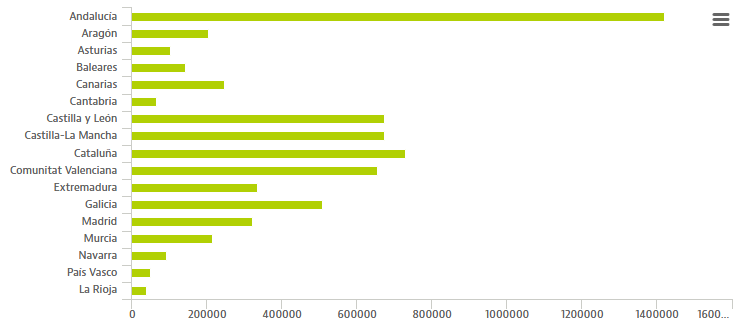
By regions in Spain, Andalusia is the Autonomous Community with the most possibilities with more than 1.4 million buildings that can install solar panels on their roofs. It is followed by Catalonia, with 730,000 blocks of flats. Castile and León and Castile La Mancha are practically on a par with 675,000 and 673,000 respectively, while close behind is the Valencia region, with more than 656,000 buildings.
Among the large residential markets, in Madrid 322,000 buildings are suitable, while in the Canary and Balearic Islands, where single-family homes are more common, the numbers lag behind. Ahead of these regions, there are some half a million suitable buildings in Galicia or 335,000 in Extremadura. The graph below compares the number of multi-family buildings that are suitable for solar panel installation in each of Spain's Autonomous Communities.
Complications come with the complexity of the Spanish electricity system, as users can use various forms of self-consumption with or without surpluses. Surplus energy can be injected into the transmission and general distribution networks, but it is not eligible for compensation. If it were eligible for compensation, the solar plant would have to comply with the same rules as any electricity production plant.
The Instituto para la Diversificación y Ahorro de la Energía, IDAE, (Institute for the Diversification and Saving of Energy) is developing a guide describing the steps required for processing self-consumption electricity generation installations of any of the types provided for in the regulations, both for individual self-consumption installations and for collective self-consumption installations. It is aimed at the general public, but more specifically at companies installing self-consumption systems. A provisional version is currently available.
"It is indeed possible to benefit from the self-consumption method with surpluses and compensation if one is a consumer associated with a nearby production facility through a network, but only in cases where the generation facility is connected to an internal network of at least one of the consumers, and where the auxiliary production services meet the requirements to be considered negligible", clarifies the Ministry for Ecological Transition and Demographic Challenge on its website.
The main electricity companies already offer plans for the installation and management of solar panels for self-consumption in residential blocks, such as EDP Energy. The plans and costs of installation will depend on household consumption and the common areas of the building, but are organised according to whether consumption is low, between 40-70 euros/month, to more than 100 euros/month, and from the first 140 euros/month in the community's electricity costs to rates of more than 190 euros/month.