The province of Almería has one of the most extensive defensive networks in Spain. This is no coincidence, as it was one of the last territories of the Kingdom of Granada to be incorporated into the Crown of Castile and remained vulnerable to pirate attacks for centuries. Below are some of the best castles in Almería to discover the region’s rich history.
Alcazaba of Almería
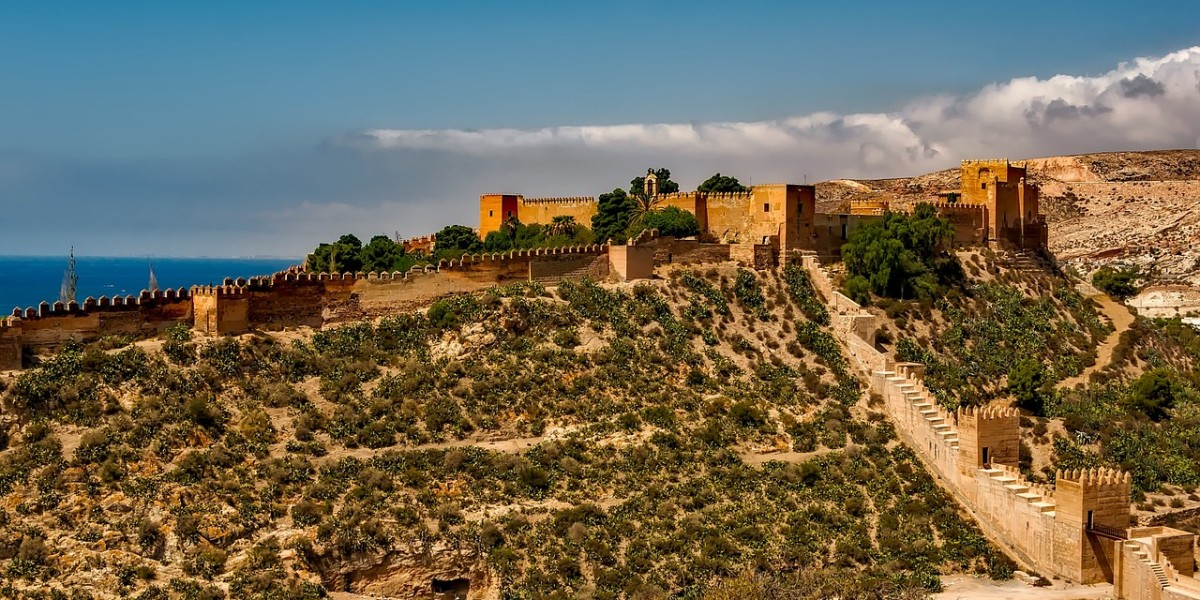
The Alcazaba of Almería is the city’s defining landmark and one of the largest Islamic fortresses in Spain. Commissioned in the 10th century by Abd al-Rahman III, it became a key stronghold of the Caliphate of Córdoba.
The walled complex extends for more than a kilometre and is divided into several distinct enclosures. Highlights include its impressive cisterns, designed to store large quantities of water, and the later modifications carried out following the Christian conquest.
Vélez-Blanco Castle
In the north of the province, Vélez-Blanco Castle stands out as one of the finest examples of Spanish Renaissance architecture. It was built between 1506 and 1515 by Pedro Fajardo, Marquis of Los Vélez, on the remains of an earlier Muslim fortress.
Part of its original decoration was removed in the early 20th century, and its famous Renaissance courtyard is now preserved at the Metropolitan Museum of Art in New York.

Guardas Viejas Castle
Guardias Viejas Castle, in El Ejido, forms part of the network of coastal fortifications built during the 18th century to defend the coastline against attacks from the sea. Its construction was also linked to the wider defensive policies promoted during the reign of Charles III.
The fortress suffered significant damage during the Peninsular War but was restored in the 20th century. Today, it houses a museum dedicated to coastal defence systems and regularly hosts cultural events and exhibitions.

Macenas Castle
Within the municipality of Mojácar stands the Tower of Macenas, also known as Macenas Castle – a robust coastal fortification overlooking the Mediterranean. It was built to monitor the coastline and accommodate artillery capable of deterring enemy incursions.
Declared a Site of Cultural Interest, the structure continued to serve a strategic purpose beyond the era of piracy. By the late 19th century, it was being used as a Civil Guard barracks – extending its role in the defence and surveillance of the area.

Tabernas Castle
Tabernas Castle, of Islamic origin, stands on a hill overlooking the desert that bears its name. During the Nasrid period, it played an important role in the defence of the Kingdom of Granada and was also the site of the surrender of Almería in 1489.
Following the Christian conquest, the fortress went through periods of both abandonment and reconstruction. Today, it survives as a consolidated ruin and can be visited freely. Its striking silhouette against the semi-desert landscape has also made it a popular backdrop for film productions shot in the province.

San Felipe Castle
Within Los Escullos, in what is now the Cabo de Gata-Níjar Natural Park, stands San Felipe Castle. It was built in 1771 to strengthen surveillance along this stretch of coastline, which was particularly vulnerable to maritime incursions.
Restored in the late 20th century, the fortress is well preserved and offers insight into the coastal defence system of the period – with its bastions, artillery positions and strategic views across the Mediterranean. Its location within one of Andalusia’s most distinctive natural landscapes further enhances its appeal to visitors.

Gérgal Castle
Gérgal Castle stands on a strategic hill at the foothills of the Sierra de los Filabres, overlooking the natural route into the Tabernas Desert. Following the conquest of the Kingdom of Granada, it became associated with the Order of Santiago before later passing into noble ownership.
Its compact design, featuring a square keep and corner turrets, is characteristic of late medieval fortress-palaces. Today, the castle remains in private ownership and is not open to the public.

Castle of the Marquis of Vélez
The Castle of the Marquis of Los Vélez, in Cuevas del Almanzora, was built in the early 16th century on the site of an earlier Muslim fortress. Its irregular layout reflects the evolution of the complex over time, combining Gothic architecture with later additions and alterations.
During the 18th century, the castle was expanded with structures such as the Casa de la Tercia, further enhancing its administrative and residential functions. Today, it is owned by the local council and serves as a cultural centre, housing museums, exhibition spaces and a public library.
- Property for sale in Cuevas de Almanzora
- Long-term rentals in Cuevas de Almanzora
- Holiday homes in Cuevas de Almanzora

How many castles does Almería have?
According to the inventory of the Spanish Association of Friends of Castles, the province of Almería is home to more than 130 castles and defensive towers – including both preserved structures and archaeological remains. This places it among the Spanish provinces with the highest concentration of fortifications, reflecting its strategic importance for almost a thousand years as a frontier territory between Europe and North Africa.