Black volcanic rock drops into clear Atlantic water, pine-scented paths lead towards cloud-covered ridges, and the coast is dotted with seawater pools rather than long rows of sun loungers. This far-western outpost once held a curious place on world maps too, serving as a reference meridian long before Greenwich took over.
It is not the Canary Islands for a resort routine, big nightlife or easy beach-hopping. The appeal is quieter: dramatic geology, protected habitats, serious diving and the sense of having reached the Atlantic’s outer edge.
The Canary Island farthest from the crowds
El Hierro is the smallest and westernmost of the Canary Islands, sitting well out in the Atlantic southwest of Tenerife. The Telegraph has described it as Spain’s least visited island, a reflection of its low visitor numbers compared with the archipelago’s larger and more heavily developed islands.
For travellers looking for Canary Islands without crowds, El Hierro is a convincing alternative to the holiday centres of Tenerife, Gran Canaria and Lanzarote. There are small villages, rural guesthouses, a handful of low-key restaurants and not much in the way of conventional resort infrastructure.
The island’s volcanic terrain is protected on a large scale. El Hierro was designated a UNESCO Biosphere Reserve, a status recognising the relationship between its ecosystems, communities and traditional rural landscape.
A volcanic island with an old role in world maps

El Hierro’s location gave it an unexpectedly important role in European cartography. Punta de Orchilla, at the island’s western end, was associated with the Ferro, or El Hierro, meridian, which served as a prime meridian for centuries in maps produced across parts of Europe.
In 1884, the International Meridian Conference adopted the Greenwich meridian as the international standard. A small monument near Punta de Orchilla commemorates El Hierro’s earlier cartographic role, in a windswept corner of the island long associated with the western limit of the known world.
Natural pools, forest walks and big Atlantic views
The best things to do in El Hierro are mostly outdoors, but the island is not one for rushing through a long checklist. Roads can be winding, weather shifts between coast and high ground, and protected areas deserve time and a bit of care.

Swim in El Hierro natural pools: La Maceta, near the village of Frontera, is one of the island’s best-known seawater swimming areas. Volcanic walls shelter a series of pools, although conditions still depend on the sea.
Charco Azul, a smaller natural pool in the north-west, has a more tucked-away feel and requires a short walk down.
Walk through the Laurisilva forest around La Dehesa: El Hierro’s highlands are markedly greener than many visitors expect.
Trails around La Dehesa and the island’s western uplands pass juniper trees shaped by constant trade winds, open pasture and misty forest.
Take in the cliffs at Mirador de la Peña: Designed by César Manrique, Mirador de la Peña looks across the steep El Golfo valley towards the north coast.
It is one of the most dramatic viewpoints on the island and gives a clear sense of the huge landslide that helped shape this part of El Hierro.
- Explore the volcanic coast around La Restinga: The southern village of La Restinga, the southernmost town in Spain, is a useful base for divers and swimmers, with darker, more exposed volcanic scenery than the greener north.
El Hierro diving, paragliding and local sport
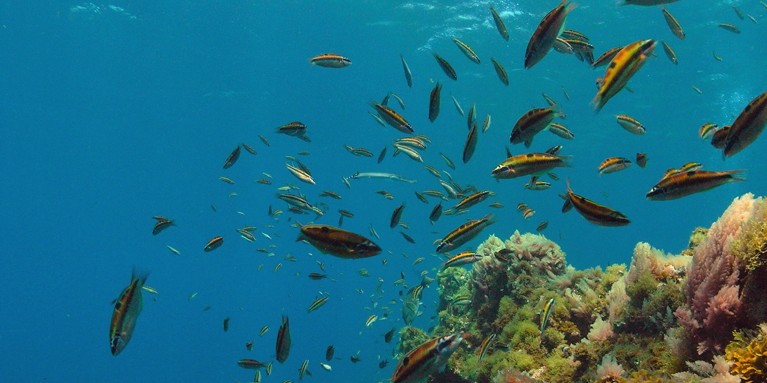
El Hierro diving is one of the island’s strongest draws. The waters around Mar de las Calmas, on the south coast near La Restinga, are valued for their clarity and volcanic underwater formations. The area forms part of the Reserva Marina de La Restinga-Mar de las Calmas, where protected waters support a wide range of marine life.
Divers may encounter parrotfish, groupers, tuna, rays and turtles, depending on conditions and season. Larger visitors, including whale sharks, are possible but far from guaranteed.
- Paragliding is another way to appreciate the island’s drops and ridges, particularly around El Golfo. It is highly weather-dependent and should only be arranged with authorised local operators.
- For a culture-led detour, look out for lucha canaria, the traditional Canarian form of wrestling. Competitors try to unbalance each other within a sand circle, using technique and timing rather than strikes.
El Hierro’s renewable-energy experiment
El Hierro has become a useful case study for sustainable travel in the Canary Islands because of Gorona del Viento, its hydro-wind power project. The system combines wind turbines with pumped-water storage, using surplus wind electricity to pump water uphill and later releasing it through turbines when wind output falls.
The project has enabled El Hierro to meet all of its electricity demand with renewable energy during certain periods, including extended runs. This does not mean every part of island life operates entirely on wind and water at all times: transport and other fuel use remain separate, while diesel generation continues to support the electricity system when renewable output is insufficient.
In 2025, Gorona del Viento supplied 43.6% of El Hierro’s annual electricity generation with renewable power. The project remains a significant effort to reduce the island’s reliance on imported fossil fuels
How to get to El Hierro

The most straightforward way to this lesser-known Spanish island is via Tenerife North Airport, where domestic flights connect with El Hierro Airport near Valverde.
Ferry services also run between Tenerife and the island’s port at Puerto de La Estaca, with routes and frequency changing through the year.
The limited connections are one reason El Hierro remains quieter than its neighbours. They also mean a little flexibility is sensible, particularly in winter, when weather can affect sea crossings and flight schedules.
El Hierro is not a substitute for a conventional Canary Islands holiday. It suits travellers prepared to slow down, spend time outdoors and accept that the Atlantic has the final say on the day’s plans.
Stay inspired for your travels in Spain—get our weekly newsletter for the latest travel guides, cultural news, and lifestyle tips.