On 29th November Spain's voters will elect a parliament, not a Prime Minister. Parliament then decides who leads the government, so the party with the most votes does not always end up in power. Here is how it works, in plain terms, and what to expect in the upcoming Spanish General Election.
In short:
- Voters elect 350 deputies (MPs) to the Congress and 208 senators to the Senate.
- Only the Congress decides who becomes Prime Minister.
- A candidate needs 176 deputies, an absolute majority, in the first vote.
- Forming a government can take weeks or even months.
Not a presidential system
Spain works more like the UK or Germany than like the US or France. There is no separate vote for a head of government. Voters choose members of parliament, and parliament chooses the Prime Minister, officially called the President of the Government. The King is head of state, but his role is ceremonial.
Two chambers, but one that counts
The Congress of Deputies (350 seats) passes the laws and the budget and chooses the Prime Minister. The Senate has 208 elected seats plus a group of senators appointed by the regions, around 260 members in all. It can amend or delay laws, but Congress can override it, and it has no say on who governs. So almost all the post-election drama is about the Congress.
How votes become seats
Spain does not hold one national count. It runs 52 separate contests, one in each of its 50 provinces plus Ceuta and Melilla. Voters pick a party list rather than a person, and each province's seats are shared out in proportion to the votes using a formula called D'Hondt, which slightly favours bigger parties.
Two things follow from this:
- Small provinces count for more per voter. Every province gets at least two seats, so sparsely populated areas are overrepresented compared with a strictly proportional split.
- Winning a seat can take far more than the official 3% minimum. Where few seats are at stake, the real hurdle is often above 10%. Parties with concentrated regional support can therefore do better than similar-sized parties spread thinly across the country.
The lesson is that national vote share is only a rough guide. The seat count in Congress is what matters.
Why voters don't choose the Prime Minister
Congress chooses the head of government in a vote called the investiture, which begins once the new chamber has met. The King proposes whoever looks best placed to win a majority after hearing the parties, and that is not always the leader of the largest party.
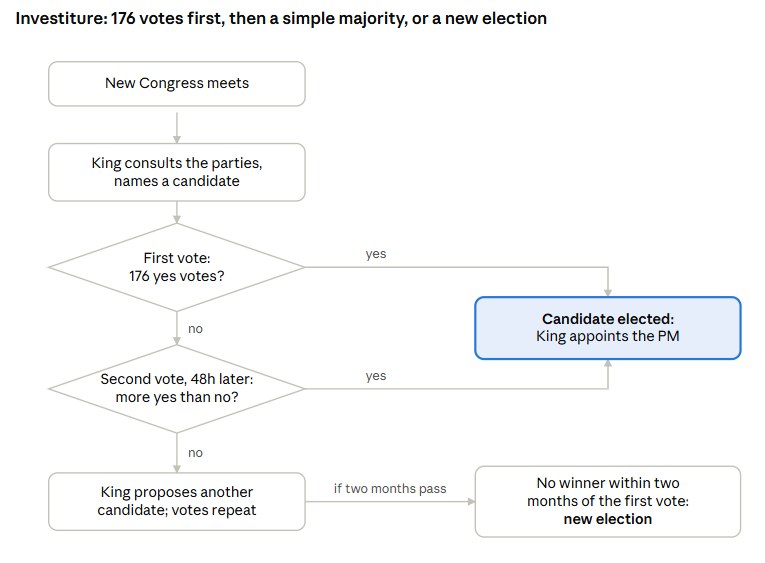
If nobody wins within two months of the first vote, the King dissolves Congress and calls a new election. That is how a party can win the most seats and still not govern.
What can happen after the vote
In recent elections no party has won an outright majority, so everything depends on who can build one. There are three routes:
- A coalition. Parties share ministries, as in January 2020, when Spain got its first nationwide coalition cabinet since the Second Republic.
- A minority government. A party governs with fewer than 176 seats and relies on others to vote with it or abstain, often regional parties from Catalonia, the Basque Country, Galicia or the Canary Islands.
- A repeat election. If nobody can win the investiture, voters go back to the polls.
The 2023 example. The People's Party won the most seats, 136 against 121 for the Socialists. Its leader failed his investiture vote, and on 16th November Pedro Sánchez won his by 179 votes to 171, about four months after the election.
A government can also fall later, but it is harder than in many countries. Deputies can remove a Prime Minister only by voting for a named replacement at the same time.
What to watch on 29th November
On election night, look at the Congress seat count rather than the vote share. The question is whether any party, or group of parties, can reach 176.
The next steps are:
- 23rd December: the new Congress and Senate meet.
- After that: the King consults the parties, and the investiture vote follows.
- Within two months of the first vote: a candidate wins, or there is a new election.
Until a government is sworn in, the outgoing one stays on as a caretaker. For foreign residents, laws already in force and your existing paperwork are not affected. Bills that were in parliament when it was dissolved have lapsed, and a caretaker government is limited to ordinary business, so big changes to immigration, housing or tax rules are unlikely to move until a new government takes office.
The next articles in our election series look at the main parties and what they propose on issues that matter to residents.