

Málaga City Council, via its Environmental Sustainability and Urban Planning departments, has unveiled one of the city’s most transformative projects: the urban integration of the Guadalmedina River.
Still at the preliminary stage, the plan aims to reconnect both banks of the river with five X-shaped bridge plazas and create a large green corridor between the Armiñán and Perchel bridges, forming a pedestrian-friendly and socially vibrant axis.
The project seeks to unify the historic centre with the western part of the city, currently divided by the river, improving mobility in one of Málaga’s busiest areas.
Fátima and Rosaleda avenues will be placed partially underground, allowing the creation of two tree-lined boulevards that expand public space along both sides of the Guadalmedina.
Green and public spaces along the river
One of the most innovative aspects of the proposal is the creation of five bridge-plazas, which will serve not only as pedestrian crossings between the riverbanks but also as new spaces for leisure and community activities for riverside neighbourhoods.
These five plazas will be located between La Goleta and Santo Domingo. The three central squares – situated between the Armiñán and Aurora bridges – will be X-shaped, each covering up to 3,000 m².
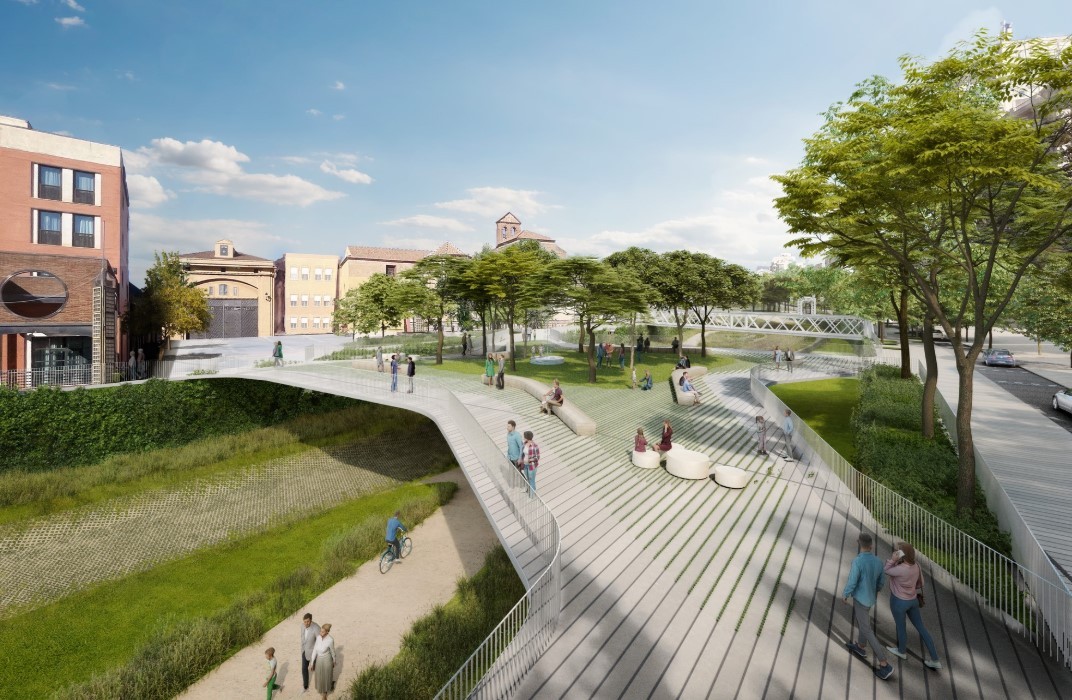
The remaining two bridge-plazas will be positioned at Santo Domingo and the current Trinidad Bridge. Each will feature play areas, seating zones and diagonally arranged pedestrian paths, promoting connectivity and integration between neighbourhoods.
Beyond the plazas, the project plans a linear green park along the riverbed, stretching from the Armiñán Bridge to the El Perchel pedestrian walkway. This initiative aims not only to restore the river’s environmental value but also to create spaces for leisure and sporting activities.
A single "problem", the flow of the river
A key aspect of the project is ensuring full compatibility with the hydraulic requirements of the Guadalmedina River. The Municipal Urban Planning Department has specified that the river must retain a drainage capacity of up to 460 cubic metres per second.
To achieve this, the proposal involves lowering and modifying the riverbed between the Armiñán and Aurora Bridges, removing existing obstacles and creating waterfalls at the section’s entrance and exit to increase the gradient. This approach reduces the current retaining walls, recovers space for the river and ensures safety during floods and torrential rain – a critical consideration given the channel’s central urban location.
Deadlines and the project's future
The project is set to be carried out in five phases, ensuring coordination between the hydraulic works, bridge-plazas and underground roadways.
The City Council estimates an investment of €86.3 million, although the preliminary project is still under development. The five-month planning period will allow for a more precise definition of each phase’s scope and budget.
Ultimately, the intervention aims to address a long-standing demand in Málaga: to transform the Guadalmedina into a space of integration and opportunity, rather than a physical and psychological barrier between neighbourhoods.

Málaga keeps its promise and suspends new tourist accommodation licences for three years
Málaga has taken a major step to balance its booming tourism sector with the local housing market. The city council has confirmed that it will suspend new licences for tourist accommodation for the next three years, following a promise made by Mayor Francisco de la Torre. This comes as part of a wider update to Málaga’s General Urban Development Plan (PGOU) and will remain in effect until new regulations are approved.