La Tomatina de Buñol is not a casual tomato-chucking session. For roughly one hour, a town of around 9,000 residents welcomes thousands of visitors, 150,000 kilos of tomatoes and a very particular set of rules. It is chaotic, slippery and a little bonkers, but the organisation behind it is serious.
The 2026 edition will be the festival’s 79th. Tickets are compulsory, capacity is limited, and sorting transport before the day saves a fair bit of faffing about.
When is La Tomatina 2026?

La Tomatina 2026 takes place on Wednesday 26 August 2026. It follows the long-standing tradition of falling on the final Wednesday of August.
The tomato fight happens in Buñol, an inland town in the province of Valencia, roughly 40 km from Valencia city. It forms part of the local festivities in honour of San Luis Beltrán, rather than being a regional holiday across the Valencian Community.
The main battle is usually held between 12 pm and 1 pm, although participants should arrive much earlier for access checks, the pre-fight atmosphere and the traditional palo jabón.
How La Tomatina in Buñol works

Before the tomatoes appear, the crowd gathers around the palo jabón: a greased pole with a jamón placed at the top. People attempt to climb it, with varying degrees of success and dignity.
A starting signal marks the arrival of lorries carrying tomatoes, which are unloaded onto the central streets. Then comes an hour of tomato throwing, red pulp underfoot and limited personal space.
A second signal ends the fight. Throwing must stop immediately at that point. Municipal cleaning teams and hoses get to work soon afterwards, and the centre of Buñol is cleared remarkably quickly.
The wider programme can also include:
- Palo jabón: the traditional pre-battle challenge
- The main tomato fight: typically 12 pm to 1 pm
- Tomatina Infantil: a separate, adapted event for children, held ahead of the main celebration
- Post-fight cleaning: municipal teams wash down the streets
- Package extras: some operators include transport, lockers, food or a post-festival party
La Tomatina 2026 tickets and prices
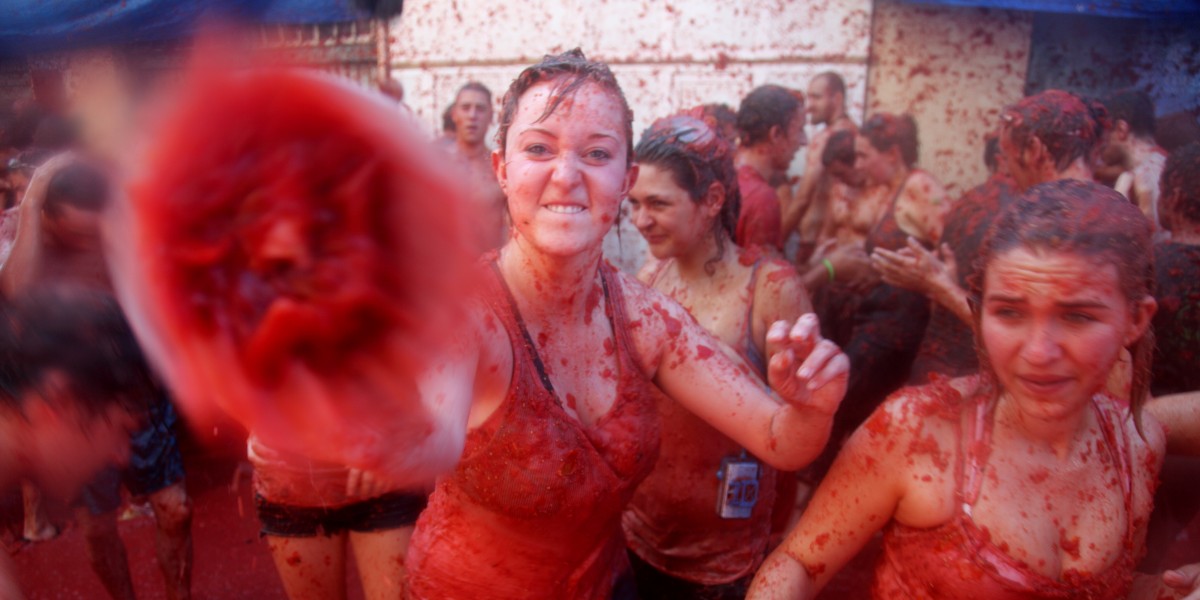
A ticket is compulsory for the La Tomatina battle. Crowd controls were introduced to improve safety, with the event limited to approximately 20,000 participants.
For 2026, the basic ticket starts at €15 and includes access to the battle area. Buy through official channels authorised by Buñol Town Council, rather than unofficial resale sites or social-media listings.
Package options vary by departure point and inclusions:
- Basic entry ticket: from €15
- Valencia packages: from €50, generally including entry and return coach transport
- Packages from Alicante, Benidorm, Calpe, Dénia or Jávea: from €110, typically including transport and admission
- Optional extras: cloakroom use, paella, sangria, a T-shirt or an after-party, depending on the operator
Residents and people with qualifying links to Buñol may be eligible for a free pre-ticket, subject to the council’s conditions and application deadlines.
La Tomatina rules worth taking seriously

The event is playful, but the safety rules are not optional. Tomato pulp turns the streets into something akin to an ice rink, while the crowd and passing lorries leave little room for carelessness.
- Squash tomatoes before throwing them. A softened tomato is far less likely to hurt someone.
- Do not throw hard objects. Bottles, cans and other solid items are not part of the event.
- Keep clear of the lorries. Give the vehicles space as they move through the festival area.
- Stop when the final signal sounds. The fight finishes immediately at the second signal.
- Bring as little as possible. Keep documents and a phone in a waterproof pouch, and leave valuables behind.
- Wear old clothes. A light-coloured T-shirt and shorts or trousers that can be stained are traditional enough.
- Choose closed shoes with grip. Trainers with secure laces and firm soles are much safer than flip-flops or sandals.
- Use swimming or snorkelling goggles. Tomato juice can irritate the eyes, particularly after an hour in a packed crowd.
- Agree a meeting place beforehand. Groups are easily separated, and mobile reception can be unreliable when everyone is trying to send the same tomato-covered photo.
Getting to Buñol for La Tomatina 2026

Buñol sits inland in Valencia province, around 40 km from Valencia city. Festival-day travel needs a bit more planning than a normal midweek trip.
Train from Valencia to Buñol
Valencia’s Cercanías C3 line connects the city with Buñol. It is a practical option in principle, but expect heavy crowds around La Tomatina.
Organised coach packages
An organised coach is often the simplest route for visitors staying in Valencia or along the Costa Blanca.
Driving to Buñol
Buñol is reached from Valencia via the A-3 towards Madrid, taking the Buñol exit. Driving can work outside the core festival hours, but restrictions, traffic and parking pressure make it less straightforward on the day itself.
The history of La Tomatina festival
La Tomatina began in 1945 during a parade of gigantes y cabezudos in Buñol’s town square. According to the most widely repeated account, a group of young people tried to join the procession, an argument broke out after one participant fell, and the scuffle spilt into a nearby vegetable stall. Tomatoes became the ammunition of choice.
The authorities stopped the incident, but some of the young people repeated it deliberately the following year. The festival was banned in the early 1950s, though local pressure helped bring it back. It grew gradually into an international event and received the title of Fiesta de Interés Turístico Internacional in 2002.
Living in Buñol beyond the tomato fight

Buñol has a completely different rhythm once the crowds have gone home. It is a compact inland town where everyday errands, schools, shops and sports facilities are generally close at hand, while Valencia remains within commuting distance.
The surrounding hills and river landscapes add proper access to walks and outdoor time, which suits people after a quieter base than the city. The trade-off is that regular life is more car-dependent than in central Valencia, although the C3 line provides a rail link.
Other unusual Spanish festivals to put in the diary
Spain’s festival calendar has plenty going on beyond Buñol’s annual tomato storm.
In Haro, La Rioja, the Batalla del Vino sees participants soaking one another in red wine on a hillside near the town. Sant Jordi in Barcelona brings books and roses to the streets each April, while the Festival de los Patios in Córdoba opens flower-filled private courtyards to visitors in spring.
Stay inspired for your travels in Spain—get our weekly newsletter for the latest travel guides, cultural news, and lifestyle tips.