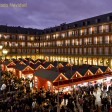
Spanish Christmas food traditions stretch well beyond Christmas Day. The main family meal often happens on Christmas Eve, known as Nochebuena, while 25 December is usually reserved for a long lunch. The season continues through New Year’s Eve and ends on 6 January with Día de Reyes, or Epiphany.
- Spanish Christmas food traditions in a nutshell
- Savoury Spanish dishes for Christmas
- Cochinillo asado in Castile and León
- Cordero lechal and cabrito asado in inland Spain
- Besugo al horno in Madrid and the north
- Mariscada in Galicia, Asturias and Cantabria
- Escudella i carn d’olla with galets in Catalonia
- Canelons de Sant Esteve in Catalonia
- Sopa de picadillo in Andalusia
- Cardo con almendras in Navarra, La Rioja and Aragón
- Festive Spanish sweets and baked goods
- Christmas drinks and New Year traditions in Spain
Spanish Christmas food traditions in a nutshell
- Christmas Eve (Nochebuena): the key family supper for many households, often featuring seafood, fish, soup or a roast.
- Christmas Day (Navidad): a long lunch with family, usually based around regional favourites and leftovers.
- 26 December: a public holiday in Catalonia and the Balearic Islands, where canelons de Sant Esteve are a traditional fixture.
- New Year’s Eve (Nochevieja): 12 grapes at midnight, one for each chime of the clock.
- 6 January (Día de Reyes): roscón de Reyes, presents and family gatherings.
Savoury Spanish dishes for Christmas
Spanish Christmas dinner is not one fixed menu. A seafood platter may be the centrepiece in Galicia, a roast in Castile and León, or a substantial soup in Catalonia and Andalusia.

Cochinillo asado in Castile and León
Roast suckling pig, with crisp crackling and tender meat, is particularly associated with Segovia and wider Castile and León. People commonly cook it in an earthenware dish and serve it simply, often with roast potatoes, onions, or a green salad.
Cordero lechal and cabrito asado in inland Spain
Milk-fed lamb (cordero lechal) and roast kid goat (cabrito asado) feature on festive tables in Castile, La Rioja and Aragón. Garlic, olive oil and rosemary are usually all that is needed, leaving the meat to do the heavy lifting.
Besugo al horno in Madrid and the north
Oven-baked sea bream with potatoes, onion and a garlic-parsley dressing is a traditional Spanish Christmas Eve dish, particularly in Madrid and parts of the Basque Country.
Mariscada in Galicia, Asturias and Cantabria
A mariscada is a seafood spread that can include king prawns, clams, spider crab and percebes, the prized goose barnacles harvested along Spain’s Atlantic coast.

Escudella i carn d’olla with galets in Catalonia
In Catalonia, Christmas lunch often begins with escudella i carn d’olla, a slow-cooked broth made with meat, bones and vegetables. The soup is served with large shell-shaped pasta called galets, sometimes filled with seasoned minced meat.
This is one of the most recognisable dishes associated with celebrating Christmas in Barcelona, although home recipes differ considerably between families.
Canelons de Sant Esteve in Catalonia
Baked pasta tubes filled with leftover roast meat and covered in béchamel are traditionally served on 26 December, Sant Esteve.
Sopa de picadillo in Andalusia
This clear chicken broth contains shredded chicken, cured ham, hard-boiled egg and, sometimes, fine pasta.
Cardo con almendras in Navarra, La Rioja and Aragón
Cardoon, a relative of the artichoke, is braised and served in an almond sauce. It is a classic Ebro Valley Christmas side dish.
Festive Spanish sweets and baked goods
Spanish Christmas sweets begin appearing in supermarkets, bakeries and specialist confectioners well before December. The names can be confusing at first, but almond, honey, sesame, anise and citrus recur across much of the seasonal spread.

Turrón de Jijona and Alicante
Turrón is perhaps Spain’s best-known Christmas sweet. The soft variety, turrón de Jijona, is made with ground almonds and honey. Turrón de Alicante is hard and crunchy, with whole almonds held together by honey nougat.
Both are protected specialities associated with the town of Jijona/Xixona in Alicante province. Modern versions include chocolate, coconut and toasted egg yolk, though the classic almond bars remain the traditional choice. You'll find them at Spain's top Christmas markets, glinting in their golden wrappers.
Polvorones and mantecados
These crumbly shortbreads are strongly associated with Estepa in Andalusia, where seasonal production has long been an important local industry.
Polvorones usually contain almonds and have a particularly powdery texture, while mantecados come in varieties flavoured with cinnamon, lemon, sesame or cocoa.
Mazapán de Toledo
Mazapán is an almond-and-sugar paste shaped into small figurines, filled pastries and bite-sized treats. Toledo is particularly associated with the Christmas version, and local confectioners sell it throughout the year, though December is the main season.
Andalusian Christmas sweets
Andalusia has a particularly broad repertoire of festive biscuits and pastries.
- Alfajores de Medina Sidonia are spiced honey sweets made with nuts, breadcrumbs and warm spices.
- Pestiños are fried pastries coated in honey or sugar, while hojaldrinas are flaky, citrus-scented biscuits.
Roscos de vino
These ring-shaped biscuits are made with sweet wine, anise and sesame, then coated in icing sugar. They are often served with coffee, liqueurs or a small glass of sweet moscatel after a family meal.

Roscón de Reyes for 6 January
Roscón de Reyes is a crown-shaped enriched bread scented with orange blossom and decorated with candied fruit. It is traditionally eaten on 6 January for Día de Reyes, not on Christmas Day itself. Bakeries tend to begin selling it after New Year, and pre-orders are common for 5 and 6 January.
One of Spain's most charming festive traditions is to hide a tiny figurine and a dry bean inside. The finder of the figurine is ‘king’ for the day, while the bean traditionally means you pay for the roscón.
Christmas drinks and New Year traditions in Spain

Cava
Cava is Spain’s traditional-method sparkling wine, produced under the DO Cava designation. Much production is centred on the Penedès area of Catalonia, though the designation covers approved locations in several Spanish regions.
Dry styles include brut nature, extra brut and brut. For bottles with more time ageing on the lees, look for Reserva and Gran Reserva.
Sidra achampanada, anís and moscatel
Lightly sparkling cider, often called sidra achampanada, is common at Christmas in Asturias and elsewhere in northern Spain. Anís, an aniseed liqueur, appears after meals across the country, while sweet moscatel is a familiar companion to Christmas biscuits and dried fruit.
Twelve grapes on Nochevieja
The most recognisable Spanish New Year food tradition is eating 12 grapes as the clock strikes midnight on 31 December. Each grape represents one month of the coming year. Supermarkets sell ready-portioned packs in the days beforehand, often with seedless grapes to make the midnight ritual a little less hectic.
-------------------------
Stay in the know about living in Spain as a foreigner—get our weekly newsletter for the latest travel, legal, and lifestyle news.